You're Not Unprofessional. Your Speech Just Wasn't Trained for Australian English.
Sound clear, natural, and confident in 3 months—
without losing who you are.

Australian English, taught by Amanda Boyce.
Certified Accent Trainer, TEFL Level 5 Diploma. Trusted by professionals learning Australian English on Instagram, YouTube, Facebook and TikTok, and by listeners of Chinwag Tuesdays, my monthly podcast.
If This Sounds Familiar...
You've lived in Australia for years. Your English is good. You read reports. You write emails. You lead projects.
But when you speak in meetings, you hesitate.
People ask you to repeat yourself. They lean in. They try to understand. And every time, that voice in your head says:
You've tried apps. You've watched YouTube. You've taken classes. But nothing helped with the real problem: your sounds, your rhythm, and your listening skills for Australian English.
So the problem stays. The fear stays. The hesitation stays.
You don't want to sound "perfect". You just want to be understood the first time. You want people to listen to your ideas, not your accent. You want to join conversations without anxiety.
Here's What's Really Happening...
You think your accent is the problem. You think "I'm just bad at speaking."
But that's not true.
Your accent isn't the problem.
Your sounds, rhythm, and listening weren't trained for Australian English. You learned English somewhere else. Australian English is different. Your brain hasn't learned it yet.
Good news: You can learn these skills. Not talent. Not genetics. Skills you can learn.
With the right training, you can fix your sounds. You can improve your rhythm. You can train your listening. In a few weeks, you'll notice changes. In 3 months, you'll speak with real confidence.
This isn't about changing who you are. It's about giving your voice the right tools.
What This Means for You...
Right now, unclear speech costs you.
It costs you confidence when you stay quiet in meetings. It costs you opportunities when others speak first. It costs you connection when you smile and nod instead of joining in.
And over time, it costs you respect. Not because you're less capable, but because people judge clear speech as smart. That's the truth.
But when you speak clearly and confidently?
Everything changes.
You walk into meetings with confidence. You share ideas without fear. You understand jokes and fast Australian speech. Your colleagues see you differently. You finally feel like you belong.
This isn't just about speaking. It's about your career. Your connections. Your life in Australia.
From Flat, Fast Speech to Confident Client Communication
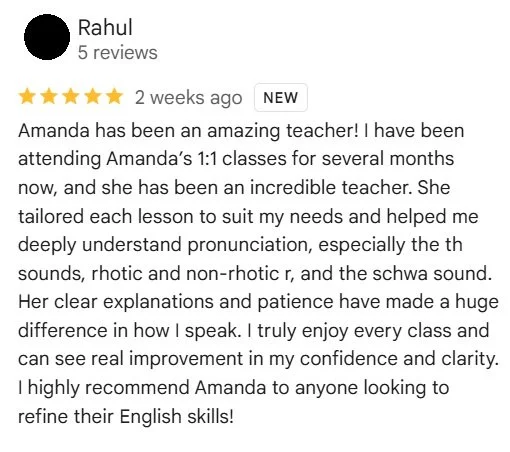
Rahul 
Sales & Marketing Professional, Sydney
Rahul worked in sales and marketing at a Sydney agency. He'd been in Australia for 4 years.
His challenge:
In client calls, he rushed through his words. People could understand him, but he often had to repeat himself. Over time, his confidence suffered.
His goal was simple: to speak clearly and naturally in any conversation.
Hear the Difference
Week 1 recording vs. post-program recording. Same person. 12 weeks apart.
No editing. No coaching during the recordings. Just 12 weeks of structured pronunciation training.
After 12 weeks of coaching:
✓ Developed a natural rhythm
✓ Learned to vary his intonation
✓ Mastered the key sounds — "th", the schwa vowel, and contractions
✓ Slowed down without losing impact
✓ His speech became clear, engaging, and professional
Now, he leads client calls with confidence.
By the end of 12 weeks, you'll also be able to:
- ✓Speak clearly and be understood the first time, without repeating yourself or apologising
- ✓Control your pace so you stop rushing, mumbling, or freezing mid-sentence
- ✓Walk into meetings, presentations, and client calls knowing how you'll sound
- ✓Follow fast Australian speech, jokes, and small talk and actually join in
- ✓Trust your voice because you'll know exactly how to practise and maintain your progress
The cost of waiting
Here's What Unclear Speech Is Really Costing You
Think about how often this happens to you already.
You're not just repeating yourself. You're losing the moments where people see how capable you actually are. How much longer can you afford to wait?
Introducing 'The Australian Accent Clarity Method'
Personalised 1:1 coaching to retrain your sounds, rhythm, and listening for Australian English.
Coaching spots are currently full. Join the waitlist to be first notified when spots reopen.
I only open 15–20 private coaching spots per year. Most fill in 48 hours. Join the list to avoid missing out.
If your English is B2–C1 but speaking still holds you back at work or socially, you're in the right place.
Most clients notice clearer sounds and smoother rhythm within the first 3–5 sessions. By around 12 sessions, they feel more confident contributing in meetings, understand Australian speech more easily, and enjoy conversations without overthinking every word.
Progress varies, but every session is personalised and focused on real-life speaking.
Meet Your Head Trainer

Amanda Boyce - Australian English Accent & Pronunciation Trainer
Amanda Boyce is a Certified English Teacher and Accent Trainer, and the founder of Aussie English with Amanda. She created The Australian Accent Clarity Method to help professionals master the specific sounds, rhythm, and listening skills needed for Australian English.
Since 2020, our team has helped engineers, IT specialists, healthcare workers, and business professionals go from being asked to repeat themselves to leading meetings with confidence.
Our focus isn't grammar or test prep. It's the specific sounds, rhythm, and listening skills that change how people respond to you in real Australian workplaces and social settings.
Before We Start:
Your Personalised Assessment
We start with an online 50-minute Accent & Clarity Assessment call to identify your specific sounds, rhythm, and listening challenges. Then we build your 12-week roadmap around what you need most.
The Assessment fee is fully credited towards the 12-week program when you enrol.
This isn't a test. It's a roadmap.
We'll analyse your speech, identify exactly which sounds and rhythm patterns are holding you back, and show you the most direct path to clarity.
You'll leave this call with:
- Clarity on which sounds need the most work (no guessing, no wasted time)
- 2–3 immediate strategies you can use straight away
- A personalised learning plan for the 12 weeks ahead
- A recording of your call to keep and review anytime
- A detailed written report of your assessment findings
- Confidence that this program is designed for your voice, not a generic script
By the end, you'll know exactly what to expect and we guarantee that you'll already feel progress.
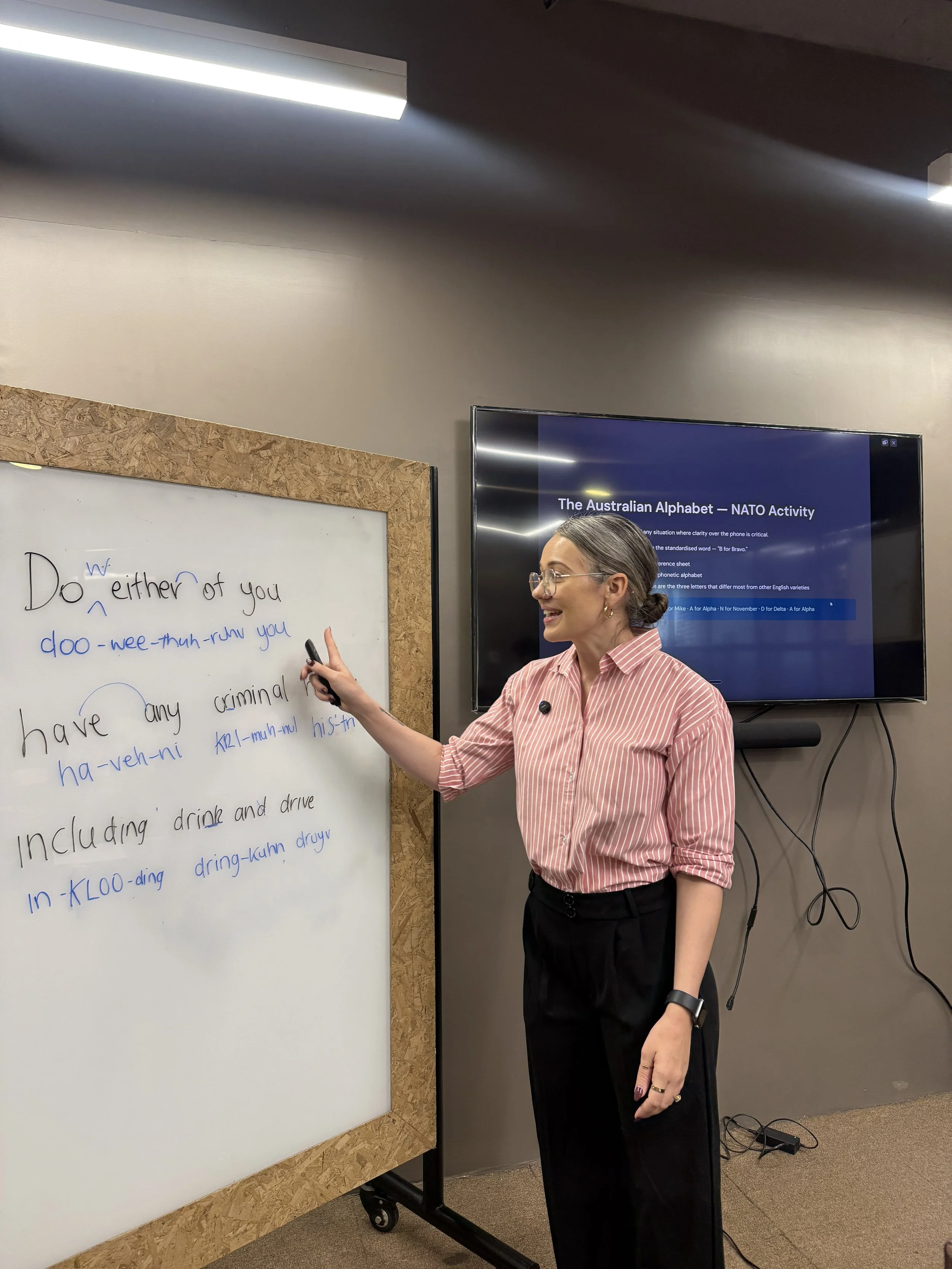
Trusted by Learners Across Australia
Real feedback from real 1:1 students, in their own words.
In Their Own Words
All completed the 1:1 Accent Clarity Transformation Program.
"I just speak without thinking now. Before I was like, okay, what am I going to say, how do I pronounce it. My head had so many thoughts, and now I just talk."
Anastasia
Marketing Professional, Sydney
"I never thought that I could transform myself like that. I always thought, ah, you know what, maybe it's my age and I can't do it anymore, but that's not the case."
Abhi
Senior Software Engineer, Melbourne
"I recommend 100 percent the program. It's worthy, and it's very clear. If you are looking for a program that tries to find the solution for your pronunciation, this is the one that you need to do."
Alejandro
Associate Client Director, Brisbane
"How would you describe your overall experience with the program?"
— Lucie
"If someone like you was on the fence about joining, what would you tell them?"
— Steph
"Would you say that there was a moment where something clicked for you?"
— Yuliia
"Was there a specific moment where you noticed a real difference?"
— Alejandro
The ACCENT CLARITY TRANSFORMATION Program
Developed using The Australian Accent Clarity Method
YOUR 3-MONTH PATH TO CLEAR, CONFIDENT SPEECH
How the Australian Accent Clarity Method Works
Every program is built around your Accent & Clarity Assessment. No two students have the same challenges, so no two programs look the same.
Here's the framework:
Phase 1: Sound Foundation
We identify YOUR problem sounds — the specific consonants and vowels blocking your clarity.
Common focus areas: th sounds, diphthongs (day, go, buy), the schwa vowel, the Australian r, v/w contrast, and word stress.
You might need all of these. You might need just two. We focus on what YOU need most.
Phase 2: Rhythm & Flow
Australian speech isn't just about sounds. It's about rhythm, intonation, and natural pacing.
We work on tone variation, strategic pausing, word-stress patterns, and how to slow down without sounding unnatural.
This is what makes you sound confident instead of rushed, and natural instead of robotic.
Phase 3: Real-World Integration
We practise YOUR real-life scenarios — meetings, presentations, client calls, and industry-specific vocabulary.
You'll learn connected speech and how Australians actually speak in fast, casual conversations.
By week 12, clear speech will be automatic — you won't need to think about it anymore.
What's Included in Your 12 Weeks
Core Training
- 12 × 50-minute private (online) lessons (weekly) — fully personalised to your voice and goals
- Accent & Clarity Assessment (50 minutes, fee credited to program) — your personalised roadmap
- Customised training plan based on your speech analysis
- End-of-month progress check-ins with updated focus areas
Ongoing Support
- WhatsApp voice-note feedback between lessons
- Full lesson recordings — review your sessions anytime
- Audio drills and practice materials for home practice
- Access to our Pronunciation Studio (valued at $749 AUD)
Results & Recognition
- Final assessment call with your maintenance plan
- Certificate of Completion
Program length: 12 weeks | Validity: 100 days from purchase
Yes, I Want Clearer Speech in 2026Client Transformations
Real results from the Accent Clarity Transformation program
Click on any card below to read the full story, hear before-and-after audio, and watch video interviews.
Anastasia 
Marketing Professional, Returning to the Workforce • 12-Week Program
Six months in Sydney, two young kids at the German International School, and an inner voice that kept telling her nobody would understand her. After 12 weeks, she read to her kids' class for Book Week and they asked for three books instead of one. Her own words: “I just speak without thinking now.”
Alejandro 
Associate Client Director, Accounting • 12-Week Program
Eighteen years in Australia, leading a team of seven offshore, and a CEO who told him directly that his accent was making communication difficult for clients. After 12 weeks, he stopped panicking when asked to run a meeting with no notice. Hearing his own before and after back to back, his reaction was immediate: “That is impressive. I'm impressed. Totally different.”
Anastasia's Journey
From an inner voice that said nobody would understand her to reading three books aloud to a classroom that kept asking for more
Hear the Difference
Week 1 recording vs. post-program recording. Same person. 12 weeks apart.
No editing. No coaching during the recordings. Just 12 weeks of structured pronunciation training.
The Challenge: "Nobody Is Going to Understand Me Anyway"
Anastasia was born and raised in Germany, though she's originally from Serbia and speaks both languages, alongside French from school and English. She moved to Sydney with her husband and two young children after her husband took on a general manager role there, and had been in Australia around six months by the time we started working together.
Before the move, she'd built a career in marketing, working her way up to head of marketing at a major consumer goods company in Germany, with roles across brands like Unilever and Nestlé. In Sydney, her two kids attend the German International School, which meant most of her daily life, from school pickups to playdates, ran in German. She'd started volunteering at Vinnies once a week specifically to get more English exposure, and had begun applying for marketing roles, though she was finding the job market difficult to break into on a visa.
She'd tried improving her English before, including doing her master's degree in London specifically to work on it, but she was mostly around other internationals there and felt it barely helped. Her reflection questions before starting showed exactly what was running through her head:
"Nobody is going to understand me anyways. I know they will ask me to repeat my question or sentence. My English is just so bad."
The Diagnosis: A Solid B2, Fast and Flat
Anastasia placed at a solid B2, with clear potential to move into C1 as her spoken exposure and confidence built. Her grammar and sentence structure were strong, thanks to her German and Serbian background, and she had excellent professional vocabulary from her MBA and marketing career. What stood out most was her self-awareness. She could already describe, in detail, patterns in her own speech that most learners take years to notice.
Key findings from the assessment:
- TH sounds coming out as D
- The short A vowel shifting toward a short E, so "hat" leaned toward "het"
- V and W crossing over in both directions
- An Australian /oυ/ sound that leaned more American
On delivery, her reading was fast with very little pausing, and her tonality was flat, which risked undercutting her in professional settings even when what she was saying was exactly right.
The 12-Week Roadmap
Every week was built around her real life: marketing interviews, the parent representative meetings she now runs at her kids' school, and everyday interactions at Vinnies and the supermarket.
Weeks 1-4: TH sounds, then the V and W distinction, since these two sounds don't overlap at all in English despite feeling interchangeable in German, then two vowel contrasts, the short A versus short E in words like "hat" and "head," and the long E versus short I in words like "seat" and "sit."
Weeks 5-7: word stress and schwa, then tonality and pace, then intonation and pausing, particularly falling intonation at the end of statements, since rising pitch can read as uncertain in an interview or a parent meeting.
Weeks 8-12: the Australian /oυ/ diphthong, the /ô/ vowel in words like "ball" and "call," the non-rhotic Australian R, understanding that R is silent after a vowel and only pronounced before one, connected speech and linking, and a final week bringing everything together in a simulated marketing job interview, drawing on her real experience at Unilever and Nestlé.
Progress Along the Way
Week 4 check-in. Anastasia said her accent was getting clearer, and that talking to Aussies had started to feel easier. What was still difficult was simply the scale of it: "So many letter pronunciations we haven't touched yet." She rated hearing her own progress, recognising mistakes in others, and identifying her own mistakes all at 5 out of 5, genuinely strong self-awareness this early on. But feeling confident producing her target sounds in conversation sat at just 2, and she was honest about why:
"If I really focus on it, I speak very slowly, and then I have the feeling that nobody knows what I wanted to say actually, including me."
Week 8 check-in. Anastasia said she was speaking more clearly, and that trying to pronounce words correctly had started to feel easier. What was still difficult had shifted to something more advanced, knowing when to use which diphthong. Her scores moved in a mixed but honest way. Hearing her own progress actually settled at 3, down from 5, and identifying mistakes in others and in herself both sat at 4. Making fewer mistakes with her sound jumped to 5. Confidence producing her target sound clearly in conversation was still sitting at 2, unchanged from week four, the awareness and accuracy were climbing, but the felt confidence of using it live hadn't caught up yet at this halfway point.
The Final Call: Listening Back
At the end of the program, we listened to Anastasia's very first reading passage next to her final recording. Hearing the first one back, her reaction was immediate:
"Oh my God. So, in general, it's very, how do you call it, hard tonality. This German accent is really strong, very monotonal. There are no intonations."
Then the final recording played, which ran nearly twenty seconds longer than the first despite being the same passage, almost entirely due to pausing:
"So much better. It's really so much better. The first one, it was really difficult for me to follow. It was also boring, I didn't get what I was reading. This time I could really follow."
Her TH had been the single biggest improvement, alongside her pace and her pausing. The one thing flagged for her to keep an eye on was a specific vowel slip in "I can't believe," where the diphthong had flattened into a single vowel sound, something small rather than a concern.
What Changed
Asked what she'd been struggling with most before the program, Anastasia didn't hesitate:
"I was struggling the most with being afraid that the Australians couldn't understand me, or they would always ask what I meant or what I said. I wasn't confident enough to pronounce it correctly. I think this changed a lot."
She pointed to a specific, vivid example, reading to her kids' school during Book Week:
"I read to them, and I had the feeling the kids were all listening and following. Before, you could see at the beginning they were following, but then in the end they weren't. This time they wanted me to read three books. I was like, oh my God."
She also described a shift in how conversations with locals felt overall: "For the first time I had the feeling they were really interested in me, and they were asking back questions, and it was really a conversation. Before, I said something and they weren't even sure what to answer." Reading her own pre-program reflection back to her, about wanting to speak without thinking about pronunciation, she didn't even remember writing it: "That's exactly it. I just speak without thinking now, because before I was like, okay, what am I going to say, how do I pronounce it. My head had so many thoughts, and now I just talk."
Anastasia's Result
The shift for Anastasia wasn't just about sounding different. It changed how connected she felt to the people around her: "I could live in Australia like this, and it would be okay. But I really can see, I get the connection to the people. Before, I was more separate."
BEFORE
- Convinced nobody would understand her
- Fast delivery, flat tonality, almost no pausing
- TH as D, short A leaning toward E, V/W crossover
- Confidence using target sounds live: 2 out of 5
AFTER
- Read three books aloud to a room that wanted more
- Natural pausing carrying real weight in her delivery
- TH consistently clear, tonality no longer monotone
- "I just speak without thinking now"
"It's amazing, and they will definitely improve. It doesn't matter where they are at the moment, they will improve, because you focus on the weaknesses."
— Anastasia, Marketing Professional, Sydney
Anastasia is continuing with her self-study worksheet, Australian podcasts and shows, and knows a check-in session is available any time she wants to prepare for something specific, like an interview.
Alejandro's Journey
From panicking when asked to run a meeting with no notice to hearing his own recording and saying "totally different"
Hear the Difference
Week 1 recording vs. post-program recording. Same person. 12 weeks apart.
No editing. No coaching during the recordings. Just 12 weeks of structured pronunciation training.
Hear From Alejandro
Read the full story below
The Challenge: When Your CEO Tells You Directly
Alejandro moved to Australia from Colombia in 2007, with a three-year stretch back in Bogotá somewhere in the middle, and has been back in Australia again for around eleven years. Spanish is his mother tongue, and he spends about 90 percent of his week speaking English, dropping to 30 to 40 percent on weekends when home life with his wife and ten-year-old son shifts back toward Spanish immersion.
He works as an Associate Client Director at a Brisbane accounting firm, leading a team of seven people offshore in the Philippines, running client calls, presenting weekly metrics, and communicating daily across time zones and accents. He came to the program through his employer. His CEO, who isn't a native English speaker herself, had told him directly that his accent was making communication difficult for some clients, and the company wanted to support him in doing something about it. They'd tried a general business English course first, but it wasn't specific enough to what he actually needed.
The Diagnosis: Classic Spanish Phonology Patterns
Alejandro placed at a high B2 to low C1 level. He already communicated with real confidence in complex workplace conversations, had strong vocabulary for his field, and had built almost all of that English through immersion rather than formal study. What stood out most in the first call was his self-awareness. He could already describe, with real precision, the moments where communication broke down:
"Some clients, I can feel that they understand what I say, so the conversation will be flowing. Some others, obviously, there are struggles. You can feel the voice or sometimes their faces. And it's like, no, I'm not following you."
Key findings from the assessment:
- An extra E sound in front of words starting with S, so "strong" became "e-strong"
- TH sounds coming out as D or T
- V substituted with B
- ED endings picking up an extra syllable
- Y occasionally slipping into a J sound
He also spoke quickly, which compounded everything else, since an unfamiliar pronunciation pattern paired with a fast pace gives a listener two things to process at once instead of one.
The 12-Week Roadmap
Every week was built around his actual job, using vocabulary from client calls, team briefings, and weekly metrics presentations.
Weeks 1-4: TH sounds, then V, then CH, the three consonant substitutions with the most day-to-day impact, then ED endings, since correctly closing off past tense verbs makes an immediate difference to clarity in a role built around describing what's been reviewed, reconciled, and submitted.
Weeks 5-7: word stress and schwa, then tonality and pace, then intonation and pausing, particularly falling intonation at the end of statements, since rising pitch can read as uncertain or tentative in a client meeting.
Weeks 8-12: the E-before-S pattern directly, the Y sound, the long A vowel in words like can't, ask, and staff, the /oυ/ diphthong, and finally connected speech and linking, using a fully unscripted final recording with no script and no preparation.
Progress Along the Way
Week 4 check-in. Alejandro rated his effort at 8 out of 10, describing exactly how he was using the material:
"The videos are really helpful to follow the correct pronunciation, and I am using the material to practice. I feel that my listening is good but still focus identifying sounds and accents."
He rated hearing his own progress and identifying his own mistakes at 5 out of 5 each, but recognising mistakes in other people's speech at just 1, which he explained candidly: "When I am with other people, I am focused on their mouth to see how they pronounce, or the position of the tongue."
Week 8 check-in. His effort score held steady at 8. What had changed was becoming able to catch himself in the moment:
"I feel that I can autocorrect myself and easily identify words and their pronunciation. I also feel that my pronunciation is a bit clearer than before."
His scores moved in an encouraging direction: recognising mistakes in others' speech rose from 1 to 3, and feeling confident producing his target sounds jumped from 3 to 5. He also offered a piece of feedback that speaks for itself: "You are a good mentor. You motivate me to keep working toward this goal."
The Final Call: Listening Back
At the end of the program, Alejandro listened to his very first reading passage next to a new recording of the same passage. Hearing the first one back, his reaction was immediate:
"Oh my god. A lot of mistakes. No intonation. No pausing. The E in front of the S, my big problem."
Then the after recording played.
"That is impressive. I'm impressed. Totally different."
His ED endings were clear and consistently self-corrected, the extra E in front of S had mostly disappeared, and the biggest shift was the tonality and emotion coming through, along with genuinely natural pausing. His after recording actually ran longer than the first, not because he was speaking more slowly overall, but because the pausing itself was doing real work. He also caught something himself that hadn't been flagged, a specific pattern where certain consonants block at the end of a sentence: "There was a strong, and it just made me like, okay, you are blocked there. The same with the B."
What Changed
Asked what had been hardest before the program, Alejandro pointed straight to the two patterns that had run through the whole 12 weeks:
"I think it was the pronunciation of the main things we worked with you, this and these, and also the EDs. I didn't realise the EDs had those three rules. Now I know how silly I was in a conversation, pronouncing the incorrect things."
On how it had shown up at work specifically, and at home, where his boss used to ask him to run meetings with no warning:
"Before, my boss would say to me in the mornings, could you please just handle the meeting today, and I was panicking. And now, even if I'm not prepared, I try to prepare a few words of what I want to say, so I can be ready. But with confidence, speaking slowly, making pauses, and vocalising every single word."
Asked which part of the program helped the most, he didn't point to the materials alone: "I think you just made me feel more interest in the program... That was the most valuable thing for this program. You, as a coach, just connect with me and guide the program to the goal."
Alejandro's Result
Alejandro didn't lose his accent.
He didn't change who he was.
He stopped panicking when asked to lead, and started preparing a few words instead, with confidence in the pauses in between.
BEFORE
- Panicking when asked to run a meeting with no notice
- Extra E before S, ED endings adding a syllable
- No intonation, no pausing, rushed delivery
- Recognising others' mistakes: 1 out of 5
AFTER
- Prepares a few words and leads with confidence
- ED endings clear and self-corrected
- Natural pausing doing real work in his delivery
- Recognising others' mistakes: 3 out of 5
"I recommend 100 percent the program. It's worthy, and it's very clear. If you are looking for a program that tries to find the solution for your pronunciation, this is the one that you need to do."
— Alejandro, Associate Client Director, Brisbane
Alejandro has opted into the four-session maintenance pack, working from around 80 percent toward 90 to 100.
Stefanie 
Postdoctoral Researcher & Tax Law Specialist • 12-Week Program
Fluent in five languages, published internationally, presenting at conferences across three continents — and still mid-sentence monitoring her own accent. After 12 weeks, colleagues in Cambridge told her unprompted that her English sounded “even better than before.” Her response: “I like it very much.”
Abhi
Senior Software Engineer • 12-Week Program
Ten years in Australia, a new baby at home, and a habit of losing his easy English the moment work pressure kicked in. After 12 weeks, colleagues stopped stalling on "Vercel" and his pacing found real pauses. His advice: “Don’t wait for it. Get on the queue.”
Sachin
Senior Data & Python Engineer • 12-Week Program
14 years of IT expertise — and still having to “trigger his brain” before every standup. After 12 weeks, Sachin delivered a major presentation to senior leaders that went “beyond expectations.” His advice: “Don’t even think about it. Just jump.”
Pav
Warehouse Store Person • 12-Week Program
12 years in Perth, working alongside mostly Aussie colleagues — and still having to repeat himself two or three times on every phone call. After 12 weeks, people stopped saying sorry and pardon. His goal next: government work. His advice: “I have the recording. If I give them that sample, they would love to join.”
Elaine 
Digital Marketer • 12-Week Program
Seven years in Melbourne, a client-facing role, and a habit of staying quiet in group conversations because the moment always seemed to pass her by. After 12 weeks, her Australian colleagues described her speech as having "excellent clarity."
Lucie
PhD Researcher • 12-Week Program
Nine years of English education, advanced proficiency — and still choosing the self-checkout to avoid talking to Australians. After 12 weeks, her colleagues noticed her “excellent clarity” and she held a one-hour conversation with strangers at a restaurant without a second thought.
Stefanie’s Journey
From mid-sentence self-monitoring to natural, confident flow — when your English is already excellent and you know it can be better
Hear the Difference
Week 1 recording vs. post-program recording. Same person. 12 weeks apart.
No editing. No coaching during the recordings. Just 12 weeks of structured pronunciation training.
Hear From Stefanie
Read the full story below
The Challenge: When “Very Good” Isn’t the Same as “Natural”
Stefanie is a postdoctoral researcher and tax law specialist. She works across Austria, the Czech Republic, the UK, and Australia — publishing research, presenting at international conferences, lecturing in three languages, and consulting as a tax advisor on the side.
Her English level at assessment was a high C1. Nobody had ever told her it was bad. Quite the opposite: colleagues consistently said it was very good.
The challenge she came with was harder to describe than a skills gap. It was the sense of knowing your pronunciation doesn’t fully match the level you’re operating at. She described it this way:
“I am aware that I tend to avoid words that I feel unsure about, knowing that they are risky with regard to my German background. I am sure that I would feel a lot more at ease if I didn’t have the feeling that it showed after a few sentences at the latest that I have this particular accent.”
What she wanted was the feeling of natural flow. Not to be working around sounds she couldn’t trust. Not to be monitoring herself mid-sentence. To feel like a genuine part of the group, not someone performing in a second skin.
The Diagnosis: Five Languages, One Persistent Pattern
Stefanie speaks German and Czech daily, maintains French and Italian, holds a Cambridge exam qualification, and was partway through a bachelor’s degree in Slavonic studies (started as a COVID side project). Her academic English had been heavily shaped by Texas-based Cambridge exam teachers — giving her a strong American influence across several sounds.
Key findings from the assessment:
- TH substitution: /d/ and /f/ in place of voiced and voiceless TH — "this" and "think" were the two most frequent targets
- V vs W contrast: A classic German first-language pattern where the distinction collapses, requiring deliberate retraining of lip rounding for /w/ and teeth-to-lip contact for /v/
- Rhotic R: A strong American retroflex /r/ to shift toward the non-rhotic Australian and British standard — particularly in everyday academic words like "research," "career," and "architecture"
- Pace: Fast in general, faster when engaged or explaining something complex — the most persistent challenge across the 12 weeks
- Schwa and word stress: Function words and unstressed syllables were receiving too much weight, giving her delivery a deliberate, read-aloud quality
- Contractions and connected speech: Formal rather than natural — technically correct, but missing the flow of native connected speech
None of this was about intelligibility. All of it was about alignment: getting the outside to match what was already happening on the inside.
The Strategy: 12 Weeks Built Around Academic and Conference English
Because Stefanie’s work lives in conference Q&As, international research presentations, faculty discussions, and consulting environments, every homework prompt and role play was tied to something she would actually encounter.
Weeks 1–2: The High-Impact Foundation
- TH sounds — voiced /ð/ ("this," "that," "methodology") and voiceless /θ/ ("think," "thorough," "third-party") — the highest-impact single change for German speakers because the substitution is so consistent and visible
- V vs W distinction — deliberate drilling before it could become automatic
Weeks 3–4: Rhythm and Vowels
- The non-rhotic R — replacing the American retroflex with the open back vowel /α/ in academic vocabulary: "research," "career," "architecture"
- Schwa work — reducing function words and unstressed syllables so rhythm moved from deliberate to natural
Weeks 5–6: Vowel Contrasts and Tonality
- /æ/ vs /ε/ vowel contrast
- Pace work — a recurring theme for the rest of the program
Weeks 7–8: Intonation and Connected Speech Foundations
- Intonation and pausing — tools for structuring arguments and signalling key findings in presentations using deliberate pitch movement
- The Australian T-flap — the difference between over-articulation and natural connected speech
Weeks 9–12: Integration and Flow
- Contractions, linking, intrusive sounds, and elision — the level that takes pronunciation from technically correct to actually natural
- Final week: simulated conference Q&A with spontaneous responses to research questions, feedback on pace, intonation and thought grouping under pressure
Mid-Program: Already Ahead of Where She Expected to Be
Week 4 Check-in
By Week 4, Stefanie had landed on the insight that drove everything forward:
“I have finally understood why my English sounds less natural. I have also understood how I can pronounce words properly depending on which accent I would like to adopt.”
Across all five self-awareness measures — hearing her own progress, recognising mistakes in others’ speech, identifying her own errors, feeling confident producing target sounds, making fewer mistakes — she rated herself 5 out of 5. All five. She rated her effort at 6–7 out of 10, acknowledging busy weeks, and her request for the lessons ahead: “Add as much nerdy stuff as you can bear.”
Week 8 Check-in
By Week 8, her focus had expanded to pronunciation accuracy across multiple accent contexts — Australian, British, and American — and to understanding the rules deeply enough to generalise them. The TH sound mid-word remained the most stubborn challenge:
“The th is very stubborn, particularly within words. I just keep on practising until it’s flowing as it should.”
Her self-awareness scores remained at 5 across the board. She gave herself 7–8 out of 10 for effort. On what could be changed about the lessons: “Stay as adorable as you are.”
The Breakthroughs: Rules, Patterns, and Wisdom Teeth
The Structural Click
Stefanie is someone who thinks in categories and rules, and the program’s approach of explaining the phonetic logic before drilling it was exactly how she processes new information:
“I just knew I need the rules. Very often, I’m also somewhat able to derive rules from patterns that I notice. But it helps me to know, okay, there are three instances where you do it like this. Then I know 1, 2, 3, and I remember this. Then I hear it somewhere, and I recognise it, and it’s just somehow burned into my brain, and I continue from there.”
Non-Rhoticity — The Aha Moment
The moment she understood not just that R drops at the end of words in Australian and British English, but why, and what happens when R follows a vowel in the next word, was the kind of insight that made the rule generalisable rather than a list to memorise.
The Wisdom Teeth Incident
During the program, a colleague at Cambridge was having wisdom teeth removed, and the conversation required her to use both "tooth" and "teeth" repeatedly — words loaded with TH sounds. By the end of that conversation, her TH production was close to perfect.
“Sometimes you need that.”
What Cambridge Noticed
Two or three colleagues told her, unprompted, that her English was really good. The framing felt different from previous compliments — as if it was even better than it already was. A retired policeman working at the faculty said he wouldn’t have noticed any German accent at all.
The Final Session: Pace as the Game Changer
At the Week 12 session, Stefanie listened to her before and after recordings side by side. Both used the same passage: a short narrative about a windy day at the river.
Her reaction to the before recording: “I thought it would be worse. It’s good to be surprised in a positive way.”
She identified what she noticed herself: the pauses felt arbitrary, the phrasing lacked clear structure, and the emotional range wasn’t where she would put it now.
Then she listened to the after recording:
“If I had to listen to it for the first time, I think that now it would be very easy for me as a listener just to follow the story, and also perhaps catch some of the emotions and feel emotional myself, just because of the drama going on in this situation.”
And then:
“I sound more confident when I speak. No matter whether it’s always correct, or how I would like to pronounce it ideally. It just sounds as if I was more aware of what I want to say, and how I want to say it. And well, it very much resonates with how I feel now when I speak.”
The pace was the most striking change. In the first recording she was moving fast enough that the emotional content of the passage was largely lost in the speed. In the second, every thought group landed where it needed to.
Stefanie’s Result
Stefanie didn’t lose her accent.
She didn’t change who she was.
She stopped monitoring and started flowing — and the outside finally matched what was already happening on the inside.
“I don’t know, it just comes more naturally that I would just engage with colleagues over lunch or dinner very naturally, even if I didn’t know them before. I’ll just make some stupid jokes. The British love this as well, which is a good thing.”
BEFORE
- Avoiding “risky” words mid-sentence
- Self-monitoring while speaking
- TH substitution, V/W collapse, rhotic R
- Pace too fast to land the emotional content
AFTER
- Natural engagement — jokes, lunch, strangers
- Cambridge colleagues: “even better than before”
- Pace controlled; every thought group lands
- “I just notice myself that I sound differently. I like it very much.”
“I cannot speak for other people, but you certainly hit a sweet spot with me.”
— Stefanie Geringer, Postdoctoral Researcher & Tax Law Specialist, Austria / Cambridge / Australia
Abhi's Journey
From a new baby cutting his English exposure to hearing himself say "amazing, honestly" about how far he'd come
Hear the Difference
Week 1 recording vs. post-program recording. Same person. 12 weeks apart.
No editing. No coaching during the recordings. Just 12 weeks of structured pronunciation training.
The Challenge: A New Baby, and English Slipping Away
Abhi is a senior software engineer in Melbourne, managing a small team and working closely with colleagues across the US. He had been in Australia for close to ten years, and at home he speaks Kannada with his wife and their daughter, who was eleven months old when the program started.
What tipped him into starting was building his own business. As he put it in the first conversation, if you have trained yourself well in the local culture, people respect you a lot more, and he wanted that same care to show up in the way he spoke, both socially and professionally.
Working from home with a new baby had quietly cut down his everyday English exposure. He was speaking more Kannada than English day to day, and his confidence was slipping in the casual settings where he used to feel most at ease, the pub, the club, small talk with people he didn't know well.
The Diagnosis: A Strong C1 With Specific Gaps
At assessment, Abhi placed at a low C1. He came in with real strengths already in place: confident delivery, a strong vocabulary, and a genuine ability to explain his ideas clearly, especially on topics he knew well. He didn't roll his R's, and after ten years in Australia his schwa was already sounding properly Australian.
Key findings from the assessment:
- V and W substitution: constantly swapping the two, so "Vercel" came out as "worse sell" and "wind" came out as "vind"
- Vowel shifts: words like "awful," "fourth," "sure" and "important" were shifting toward a shorter, flatter sound
- Initial T and D: landing a little too far back in the mouth
- TH under pressure: reverting to a T when he was stressed or moving fast
- Pacing: speeding up the moment he relaxed into a familiar topic, taking his intonation with it
None of this was about fluency. Abhi could already say what he meant. The work was about making sure his words landed exactly the way he intended, every time, not just when he was reading carefully off a page.
The 12-Week Roadmap
The roadmap was built around Abhi's actual working life: stand-ups, sprint planning, pull requests, deployments, and the everyday vocabulary of a software engineer.
Weeks 1-4: V and W substitution using his own workplace words (version, review, develop, workflow), TH sounds drawn from stand-up language (think, without), the vowel in "awful" and "fourth," and initial T, all practised against his sprint tickets and technical timelines.
Weeks 5-8: word stress and the schwa using words like "development" and "documentation," tonality, pace and intonation, teaching Abhi to slow down deliberately under pressure rather than let his pace run away from him, and initial D.
Weeks 9-12: the diphthongs in "go" and "day," the seat versus sit distinction, and connected speech and linking, pulling every sound together into the kind of relaxed, joined-up delivery Abhi would actually use explaining a project to his team.
Progress Along the Way
Week 4 check-in. Abhi said plainly, "I know where I'm making a mistake," and that some words felt much clearer already. What was still catching him out was anything unscripted:
"I find it difficult when things aren't scripted. I'm trying to slow down but still feel like my practice sessions at home are going well. However, when I'm on a work call my words seem to fall apart."
He rated his effort at 7 out of 10 and described his overall progress as Somewhat Confident.
Week 8 check-in. The language had shifted from correcting to recognising:
"I can totally understand what words I not saying correctly. I am improving the way I speak with schwa sound and everything else."
His main ask wasn't more correction, it was more repetition: "Just having a bit more of practice materials. May be an app or something that can be used on the go." His confidence rating held steady at Somewhat Confident, but the shift in his own language was the real signal, awareness tends to arrive before confidence catches up.
The Final Call: Listening Back
The program closed the way it always does, listening to Abhi's very first recording next to the one he had just submitted. Hearing himself read the windy day at the river passage from week one, Abhi didn't hold back:
"I'm sure I would change a lot of things from there. That was actually quite robotic, to be honest, now that I hear about it. And also, a lot of pronunciations are way off the mark."
Nearly every V in that first recording had come out as a W. Then the after recording played:
"Oh, yeah, heaps of difference, honestly. But still, I need to improve a lot. I don't think that's still how I nailed it."
He noticed the schwa himself before anything was said. The clearest difference was his V's, clean and consistent on words like "river" and "David" where the first recording had blurred them into W, and his pacing, with real, intentional pauses replacing the rushed delivery of week one.
When asked how it felt hearing himself now, Abhi didn't hesitate: "Amazing, honestly. I never thought that I could transform myself like that. I always thought, ah, you know what, maybe it's my age and I can't do it anymore, but that's not the case."
Abhi's Result
The clearest marker of Abhi's growth wasn't a score, it was the story he stopped telling himself. Before the program, he had quietly decided his age might be the reason he couldn't change how he spoke. By the final call, that belief was gone, and he'd started catching himself mid-conversation to check whether he'd said something clearly: "Now I would still talk, but then I'm thinking, hey, did I say that right? Was there any confusion over there?"
It showed up outside sessions too. "I don't think there is any time now that people don't understand me," he said. His wife told him he now "sounds way more local than what it used to be before." And the mispronunciation of "Vercel," the platform his team uses daily, that used to make colleagues visibly stall trying to work out what he meant, was simply gone once the V was fixed.
BEFORE
- V and W blurred into each other
- Rushed, robotic-sounding delivery
- Words falling apart on unscripted work calls
- Quietly blamed his age for the gap
AFTER
- Clean, consistent V's on "river" and "David"
- Real, intentional pauses under pressure
- Colleagues no longer misunderstanding "Vercel"
- "That's not the case" about his age
"Don't wait for it. Get on the queue." And on the excuse that it's too late to change how you speak: "No, mate, no, you're not old, you're just not doing it."
— Abhi, Senior Software Engineer, Melbourne
Sachin's Journey
From "monotone technical" to "confident communicator" — how a Senior IT Engineer removed the final barrier to leadership
Hear the Difference
Week 1 recording vs. post-program recording. Same person. 12 weeks apart.
No editing. No coaching during the recordings. Just 12 weeks of structured pronunciation training.
The Challenge: When Good Enough Isn't Enough
Sachin had built a solid career. Over 14 years in IT, now working as a Data and Python Engineer in Sydney. Strong vocabulary, professional clarity, and a C1 level of English. By most measures, he was a confident communicator.
But there was a gap — and he felt it every day.
"My updates, opinions, talks, and presentation should flow like a story and not a dull podcast."
What was actually getting in the way:
- The monotone delivery: He knew his tone was flat. He didn't want to "come out as a monotone" but couldn't yet hear how to change it
- The mental load: Before speaking, he was consciously managing what to say, how to say it, the accent, the pronunciation — all at once. He described it as his mind "trying to handle multiple things at one moment"
- The delayed response: "Sometimes I come up with a good response after the incident has happened." By the time he'd processed everything, the moment had passed
- Small talk: As a self-described introvert, casual conversation with colleagues was something he pushed himself into even when it felt awkward
His goal was clear: to keep the audience engaged, to sound like a story not a podcast, and to let his communication flow as naturally as his native Marathi and Hindi.
The Diagnosis: Identifying the Friction
At the initial accent assessment, Sachin read a passage aloud and answered questions so his specific patterns could be identified. His English was strong — but several phonetic habits were creating unnecessary friction for Australian listeners.
Key findings from the assessment:
- TH sounds: Substituting /θ/ and /ð/ — "think" and "this" were being approximated with similar but noticeably different sounds. In technical contexts, "third-party APIs" took on a slightly different quality
- The rolled R: A strong Indian English /r/ in words like "report," "career," and "result" — replaced over the program with the relaxed, non-rhotic Australian pattern
- Rising intonation on statements: Ending declarative sentences with an upward pitch — a pattern that can unintentionally signal uncertainty rather than authority in Australian workplaces
- Diphthong flatness: Key vowels like /eɪ/ ("data," "display") and /oʊ/ ("role," "project") were being produced without the full glide movement Australian listeners expect
- Schwa and word stress: Over-articulating unstressed syllables — making speech sound precise but effortful rather than natural
None of these were errors in vocabulary or grammar. They were the final layer — the technical sounds and rhythm that create the gap between "clear" and "natural."
The Strategy: 12 Weeks, One Sound at a Time
The roadmap was built specifically around Sachin's professional world — his IT vocabulary, his workplace communication goals, and the sounds that would make the biggest difference to how he came across in meetings and presentations.
Weeks 1-4: The Foundations
- Week 1: TH sounds — tongue placement applied immediately to workplace vocabulary ("third-party," "method," "thorough")
- Week 2: The /eɪ/ diphthong — "data," "display," "name" — with mouth movement practice
- Week 3: Word stress and the schwa /ə/ — reducing unstressed syllables so speech sounds less over-articulated ("customer" → "KUHS-tuh-muh")
- Week 4: Intonation and pausing — using pitch changes and purposeful pauses for clarity and authority
Weeks 5-8: The Aussie Shift
- The /oʊ/ diphthong — "role," "project," "remote," "portfolio"
- R sounds: removing the rolled /r/ and building the relaxed Australian pattern
- Non-rhoticity: dropping the final /r/ in "server," "error," "feature," "deliver"
- Shadowing Australian content — Mr. Inbetween and Utopia — to absorb local pitch, pauses, and rhythm
Weeks 9-12: Flow and Connected Speech
- V/W contrast
- Linking and connected speech — making technical terms flow as a single unit rather than word by word
- Tonality and pacing for presentations and standup meetings
Mid-Program: Progress Already Showing Up at Work
By Week 4, Sachin completed his first check-in. The main focus at that point was accent clarity — and he was already noticing real changes in his daily life.
"There is definitely change in the accent and pronunciation in daily conversation — and at work."
What felt easier: connecting and linking words. What was still a stretch: intonation — he noted it was "taking a little extra effort" given the influence of the languages he'd grown up with.
How he rated his overall progress at that point: Very Confident.
He also noted something that doesn't get talked about enough — he could hear mistakes in others' speech too:
"I can recognise the mistakes if someone mispronounces something."
By Week 8, the shift had deepened. He described using Aussie-style words, phrases, and sentences in his daily life — including at work. Connecting words and diphthongs were coming more naturally. And his self-awareness had sharpened further:
"I can easily figure out what's wrong and what should have been — in daily conversations."
Again: Very Confident.
The Moments That Stood Out
The Big Presentation
Partway through the program, Sachin had a major presentation at work — what he described as a "huge bake presentation" in front of senior people in his organisation. He'd prepared not just the content, but the delivery.
"That was a really power booster for me because it went really well beyond my expectation."
The Barista Moment
In his post-program call, Sachin described something that might sound small but meant a lot. In his early months in Australia, ordering a coffee involved mental translation — thinking in Marathi or Hindi first, then converting to English. By the end of the program:
"These days, it comes to me naturally. I don't have to spend that much time or think about it — not just the English. The accent is also coming in naturally."
The Self-Talk Habit
In his reflection, Sachin described something he'd started doing on his own: talking to himself in English — "like a Dexter monologue," as he put it. Combined with watching technical tutorials and Australian content, this habit helped him internalise the sounds outside of lessons, on his own terms.
End of Program: Hearing the Difference
At the final session, Sachin listened back to his Week 1 recording alongside his post-program recording. His reaction in the moment said everything.
On his Week 1 recording:
- "I could see there was lack of pacing up and down"
- "Pauses were not at the right places in some sentences"
- "I could have done better connecting the words"
After listening to his post-program recording:
"This is much, much better. I can see emotions and expressions in the voice. The intonation is good. The accent is definitely there... it sounds much better."
He also reflected on something important about how progress works:
"When you indulge in conversations, you won't see that much of progress or improvement, but when you listen to this before and after, there's definitely a progress."
The end of program report confirmed: strong progress in TH sounds, diphthongs, schwa and word stress, the R sound, connected speech, and self-monitoring. The standout quality noted was his awareness — noticing patterns, correcting in real time, and applying what he'd learned in his actual work.
Sachin's Result
Sachin didn't lose his accent.
He didn't change who he was.
He removed the final layer of friction — and let his expertise lead.
BEFORE
- Managing accent, pronunciation and content simultaneously
- Flat, monotone delivery in updates and presentations
- Good response arriving after the moment had passed
- Mentally translating before speaking
AFTER
- Presentation went "beyond expectation"
- Emotions and expression in the voice
- English and accent coming naturally
- No more "out of place" feeling
"I would tell them, jump. Don't even think about it. Just jump. There is definitely a reward at the end."
— Sachin, Senior Data & Python Engineer, Sydney
Pav’s Journey
From repeating himself on every phone call to knowing exactly what to do with his mouth, his pace, and his voice
Hear the Difference
Week 1 recording vs. post-program recording. Same person. 12 weeks apart.
No editing. No coaching during the recordings. Just 12 weeks of structured pronunciation training.
The Challenge: 12 Years In, Still Repeating Himself
Pav has lived in Perth for 12 years. He came from Haryana, did his IELTS, scored 5.5, and built his life here. He works Monday to Friday in a warehouse — operating a forklift, managing customer orders, making phone calls to arrange deliveries.
He’d spent a decade on night shifts working mostly with other Indians. Then he moved to a warehouse job where almost everyone around him was Australian. The gap became impossible to ignore.
“The only thing I worry about at work is what if they don’t understand my accent, or if I pronounce any word totally wrong, or if they think I know less English.”
The phone was the hardest part. Face-to-face, people could read his expressions and guess the gaps. On the phone, there was nothing to fall back on. He’d be asked to repeat himself two or three times until the other person finally guessed what he was saying.
“When someone is in front of you, it’s easy to understand or guess what the other person is trying to say. But on the phone, it’s the opposite.”
He was also working toward government work and had been applying for roles with the WA government, where communication and clarity matter.
He did his research. He knew what he was looking for: not general English, not vocabulary lists, not slang. He explained it in the final session: “The main thing is, I would say, mouth positioning and the live practice. There are 100 options out there, but I did my research and I chose your program.”
The Diagnosis: High-Frequency Patterns From Hindi and Punjabi
At assessment, Pav placed at a solid B1 edging into B2. He communicated clearly enough in his workplace and managed customer interactions. The issue wasn’t comprehension or vocabulary. It was the specific sounds that created friction.
Key findings from the assessment:
- The /eι/ diphthong: Words like "David," "today," "take," and "weight" were coming out flat rather than gliding — the vowel was stopping too early instead of travelling through its full two-part movement
- V vs W: A very common pattern from Hindi and Punjabi, where V and W are the same letter. In English they are completely separate sounds — teeth to bottom lip for /v/, rounded lips only for /w/. This distinction appears everywhere in his work vocabulary: vehicle, invoice, delivery, weight, warehouse, available
- TH sounds: Substituting /d/ in place of both voiced and voiceless TH — one of the most consistent patterns from a Hindi and Punjabi background
- The rolled R: Tongue tapping the roof of the mouth, particularly strong at the start of words — needs to stay low and flat in Australian English
- The /oυ/ diphthong: Words like "no," "cold," "home," and "load" were missing the full mouth movement
- Pace and intonation: Flat and fast in a way that compressed the space for clarity and removed the up-down variation that makes speech easy to follow
The Strategy: 12 Sessions Built Around His Actual Life
Every sentence example, every word list, every speaking activity was drawn from Pav’s actual daily life: warehouse operations, customer calls, and forklift handovers.
Session 1: TH sounds — starting here because TH is both high-frequency and highly visible. You can practise in front of a mirror and immediately see whether the tongue is in the right position. In Hindi and Punjabi, TH is pronounced at the roof of the mouth or behind the teeth, not between them.
Session 2: V vs W — in Devanagari script, V and W share the same character. Getting clear lip rounding for /w/ and strong teeth-to-lip contact for /v/ required deliberate drilling: vehicle, invoice, delivery, weight, warehouse, available.
Session 3: The /eι/ diphthong — learning to let the vowel glide fully rather than stopping too early. Practising with the days of the week: Monday, Tuesday, Wednesday — every day containing that /eι/ sound.
Session 4: The rolled R — the Australian R stays low and flat. The tongue does not lift, tap, or touch the roof of the mouth. Working through word-initial R slowly before gradually building pace back.
Sessions 5–6: Word stress, schwa, and non-rhoticity — learning which syllables to stretch and which to compress, plus the word-final R that Australian English drops. "Driver" becomes "driva." "Customer" becomes "customa."
Sessions 7–8: Tonality, pace, and intonation — where the flat, fast delivery gave way to something with shape and movement. Learning where to pause, when to rise, when to fall.
Session 9: The /oυ/ diphthong — exaggerating the mouth movement at first: open, then round and close. Cold. Road. Phone. Hold.
Sessions 10–12: Connected speech, linking, and final showcase — bringing everything together, comparing recordings, and preparing for the conversations ahead.
Mid-Program: From Noticing to Knowing
Week 4 Check-in
By Week 4, Pav’s main focus was self-awareness. He was noticing the V and W in real time as he spoke — exactly the right first stage. He rated himself 5 out of 10 for practice effort, honest about the fact that working full time and having a newborn at home (his daughter was born in May 2026, near the end of the program) limited his available time outside sessions.
His self-awareness scores were 3 out of 5 across the board: sometimes hearing his own progress, sometimes recognising mistakes, sometimes catching himself. A solid and realistic midpoint for someone four weeks in with limited practice time.
What he needed: more feedback, more corrections. “Practice and more practice” was his plan. He was happy with the current pace and had nothing to change.
Week 8 Check-in
By Week 8, something had shifted in a way that went beyond scores. He wrote:
“I think my confidence has improved the most. I feel people understand me the first time, so I no need to repeat myself all the time.”
That was his original goal. Named in his pre-program questions. By Week 8, he could feel it happening.
His effort score had moved up to 6. Self-awareness scores were 3–4 across the board. He was self-correcting in real conversations and hearing his own mistakes under pressure.
The Breakthroughs: Knowing Why, Not Just What
Mouth Positioning — The Core Shift
When Pav reflected on what helped most, he was precise:
“The correct mouth positioning. Now I know how to say A. Words are flowing much better. It’s much more natural when I say anything, because I know now how to say any word — if I’m using A, R, what I have to do with my tongue or mouth, when I have to use my lips or not. So, yeah, these things. Now I know, and I’m self-aware when I say anything.”
The Real-World Measure
Pav’s measure of change wasn’t a form or a recording. It was his colleagues and customers:
“When I go out, people are not saying sorry or pardon to me when I speak. They are saying it less compared to before. So that means I know I’m on the right track.”
The Shift at Work Under Pressure
Before the program, when Pav needed to explain something in detail, he would sometimes just stop and cut the conversation short because it was getting too hard. By the end of 12 weeks:
“Now I’m not worried about my grammar. So I know, if I’m speaking in the right way, they can understand. So I speak more clearly and confidently.”
Reading — The Habit He Started
Outside sessions, Pav had started reading books: “Now I’m reading the book, so I think before I say anything. I have to calm down, and I have to speak slow.” He was doing this while navigating a newborn at home and family visiting from India.
The Final Session: Before Was “School Homework”
In the final session, Pav listened to his Week 1 recording and then the recording he’d submitted the week before.
His own assessment of the before recording was immediate and unfiltered: “Yeah, that’s totally shit.”
He noticed the intonation first, or the absence of it: “No up-down. I’m just saying everything in one tone.” Then the pace: “Bit fast.” Then the image that stayed:
“It’s like my school homework. I just want to finish.”
When the second recording played, he listened carefully. Then:
“I think the R, I have strong control. And I’m not much fast compared to the first one.”
The most telling moment wasn’t in the recording comparison. It was what Pav said when asked how he felt hearing himself in that second recording:
“More confident, I would say. Before, I don’t know what I’m doing. I’m just speaking. I don’t know if I was right or wrong. But now I know where I have to pause when I speak.”
That shift — from not knowing to knowing — is the whole program in a sentence.
Pav’s Result
Pav didn’t lose his accent.
He didn’t change who he was.
He stopped just speaking — and started knowing exactly what he was doing and why.
BEFORE
- Repeating himself 2–3 times on every phone call
- Flat, fast delivery — "school homework"
- Cutting conversations short when they got hard
- Not knowing if he was right or wrong
AFTER
- People understand first time — fewer sorry/pardon
- Pace controlled, intonation present
- Speaking more clearly and confidently at work
- “Now I know where I have to pause”
“I would recommend 100%. I have the recording — my first one, and the latest one. So I can show them how I spoke before, and how I’m speaking now. If I give them that sample, they can see the difference. They would love to join.”
— Pav Singh, Warehouse Store Person, Perth
Pav is continuing with monthly maintenance sessions, working toward his goal of government work.
Elaine's Journey
From losing the moment to speak up in meetings to being told her English had "excellent clarity"
Hear the Difference
Week 1 recording vs. post-program recording. Same person. 12 weeks apart.
No editing. No coaching during the recordings. Just 12 weeks of structured pronunciation training.
The Challenge: Softly Spoken, and Missing the Moment
Elaine is a digital marketer in Melbourne. She runs Facebook and Google Ads for clients, and over the past year had moved into a client-facing role, presenting proposals directly to the people whose budgets she managed. She moved to Melbourne from Malaysia seven years ago, and Chinese was her first language all the way through school and university.
Elaine could already name the problem clearly. In her reflection questions before starting, she wrote that communication confidence looked like being able to communicate her thoughts and logic without worrying the other person didn't understand her.
Her manager had given her feedback that she spoke too softly. In group settings, she often had something to contribute but couldn't find the moment to say it. By the time she'd finished forming the thought in her head, the conversation had moved on, and it looked to everyone else like she simply didn't have an opinion.
The Diagnosis: A Strong B2 Edging Into C1
At assessment, Elaine placed at a strong B2, edging into C1. Her grammar and sentence structure were strong, her ideas were clear and logically explained, and she had excellent professional vocabulary for her role in digital marketing. She was also getting a huge amount of daily English exposure at work and at home.
Key findings from the Accent and Clarity Report:
- TH sounds in words like think, this, with and three
- Clearer word endings, both the ED past tense endings and plural endings
- The difference between the E and I vowel sounds in words like seat and sit
- The AY sound in words like engage and translate
- Connected speech generally, so her endings would carry through into the next word instead of disappearing
She also found it hard to follow fast Australian speech and jump naturally into group conversations, and had a tendency to think in Mandarin first, which slowed her down mid-conversation.
The 12-Week Roadmap
Every practice sentence was built around Elaine's actual job, using words like client, project, market and update, because that's what she was saying all day in calls and meetings.
Weeks 1-4: TH sounds, the final stop sounds P, T and K, the long and short vowel contrast, and ED endings.
The program paused for a stretch after week four while Elaine brought on extra help to grow her team, then picked back up.
Weeks 5-7: word stress and the schwa sound, tonality and pace, and intonation and pausing, because by that point her sound production had come a long way and the next layer was how she used pitch, pace and pausing to sound warm and engaged rather than flat or uncertain.
Weeks 8-12: plural S endings, the AY diphthong, the AW sound in words like talk and thought, connected speech and linking, and a final week on consonant clusters (asked, tasks, texts), ending with a showcase bringing everything together in natural, connected speech.
Progress Along the Way
Week 4 check-in. Elaine said what had felt easier was, in her words, "'the' :D". What was still difficult was connecting speech. She rated her effort at 5 out of 10 and was honest about why:
"Thanks for offering a pause for my course. As we've hired someone to grow the team I do feel like I have the mental space and more prepared to come back stronger. I want to get better each day, not aiming for perfection but the consistency of it."
Week 8 check-in. The tone had shifted. What Elaine noticed changing was "the pronunciation of 'TH', speech connecting, and the D, T, ED, P at the end." Her self-assessment scores moved from mostly 2s and 3s to mostly 4s out of 5, a real jump in self-awareness and confidence over four weeks, even with her effort score holding steady at 5. The work was landing.
The Final Call: Listening Back
At the end of the program, Elaine listened to her original assessment recording next to her final one. Her reaction to the first:
"Sounds very Chinese. There's a lot of, you know, my accent, the thing that you pointed out in this course, right? The P is drop. The T and the TH... Another thing is the intonation, the pace and tonality."
Her reaction to the after recording was measured rather than triumphant, which is often the more honest kind of progress:
"I think they're better... The second one, it's a lot more using, like, you know, some words, you lower the tongue, or the TH, I noticed, like, some words I still couldn't say it, but I think some of the other parts were okay. And the pace as well, it's, it's better."
She also noticed her own listening had changed: "I think my ear is more sensitive now too. When people say certain words, I'm able to pick up on that is actually how we should say it."
Elaine's Result
Elaine compared pronunciation progress to something more visible like weight loss: "It's not like, okay, you put in this effort, you expect to see one, two kilos down next week... but as I practise, at one point it just clicked." About 60 percent of her colleagues are local Australians, and hearing them use the same sounds she'd been practising became its own kind of proof:
"I'm recognising those words and I'm hearing how my co-workers are saying that, like, they're all local, they're all Aussie, kind of validate my feeling of actually you don't have to be afraid of saying that out loud because that's actually the correct way of saying it."
Reading her own words back to her, the ones she'd written before starting about wanting to communicate without worrying she wouldn't be understood, she said: "It doesn't seem like they're asking me to repeat myself more recently."
BEFORE
- Dropped P's, T's, TH and ED endings
- Missed her moment to speak in meetings
- Thinking in Mandarin first, then translating
- People asking her to repeat herself
AFTER
- Clearer endings, connected speech improving
- A more sensitive ear for her own mistakes
- Colleagues' speech confirming her own progress
- Rarely asked to repeat herself now
"When we learn a certain topic by ourselves, there's no other person pointing out what was the mistake. You pointed out the areas that I need to work on. I wouldn't be able to know I'm dropping the ED sound, if you didn't say it out. I've been talking like that for many years."
— Elaine, Digital Marketer, Melbourne
Lucie's Journey
From avoiding native speakers at the supermarket to holding her own at a crowded restaurant — in 12 weeks
Hear the Difference
Week 1 recording vs. post-program recording. Same person. 12 weeks apart.
No editing. No coaching during the recordings. Just 12 weeks of structured pronunciation training.
Hear From Lucie
Read the full story below
The Challenge: The "Advanced" Speaker's Trap
Lucie had nine years of English education behind her and tested at an advanced proficiency level. People understood her. By most measures, she was doing fine.
But Lucie knew something was off. Her German sentence structure and accent made her feel less natural — and that feeling had quietly shaped her behaviour in ways she hadn't fully admitted to herself.
"Before, I was searching for words and overthinking. Now, it's just in the flow."
The private habits nobody talks about:
- The supermarket test: She actively chose checkouts staffed by non-native speakers to avoid the stress of spontaneous interaction with Australians
- The social noise barrier: Group conversations and noisy lunch rooms required such intense concentration that she'd often go quiet rather than try to keep up
- The spontaneity gap: In meetings, she'd overthink her phrasing until the moment had passed and someone else had moved on
- The ChatGPT crutch: She was asking ChatGPT how to phrase things before sending professional messages — just to make sure they sounded natural
She wasn't struggling with English. She was struggling with the gap between how she thought in German and how she needed to communicate in Australian English.
The Diagnosis: German Meets Australian English
The initial accent assessment identified the specific phonetic patterns from Lucie's German background that were creating friction with Australian listeners.
Key findings:
- The Hard R: German uses a strong uvular /r/ — completely different from the soft, non-rhotic Australian pattern. Every word ending in R was a giveaway
- TH Sounds: /θ/ and /ð/ don't exist in German, so "think" and "this" were being approximated with similar but noticeably different sounds
- Flat Delivery: German is a syllable-timed language — every syllable carries similar weight. Australian English is stress-timed, with strong peaks and heavily reduced unstressed syllables. Lucie's speech sounded even and measured where Australian ears expected rhythm and flow
- Vowel Contrasts: Key pairs like "seat" vs "sit" were too close together, occasionally causing miscommunication in professional contexts
The assessment also revealed a strong foundation: Lucie's grammar was excellent, her vocabulary was wide, and she had a good ear. The work wasn't starting from scratch — it was targeted refinement.
The Strategy: Three Pillars Over 12 Weeks
Rather than generic English practice, the program was built around three focused pillars tailored to Lucie's specific German-to-Australian friction points.
Pillar 1: Technical Precision (Weeks 1-4)
- The soft Australian /r/ — replacing the German uvular R with the relaxed non-rhotic pattern
- TH sounds (/θ/ and /ð/) using the "teeth sandwich" technique, applied to her research vocabulary immediately
- Vowel contrasts: "seat" vs "sit," "bad" vs "bed" — the pairs most likely to cause confusion in academic settings
Pillar 2: The Aussie Rhythm (Weeks 5-8)
- Schwa awareness — recognising and producing the unstressed /ə/ that gives Australian English its relaxed, flowing quality
- Linking and reductions — how Australians connect words in natural speech ("gonna," "wanna," "shoulda")
- Moving from flat, even-stressed delivery to the peaks and valleys of stress-timed English
Pillar 3: Listening Discrimination (Weeks 9-12)
- Focused ear training using Australian media — specifically Utopia and The Project
- Learning to hear the details of native speech rather than processing it as a blur
- Applying new sounds in real-time conversations without overthinking
The Journey: Two Breakthroughs That Changed Everything
Week 4 — The Self-Correction Shift
By Week 4, something had quietly changed. Lucie wasn't just producing new sounds in practice — she was catching her own errors mid-conversation and correcting them in real time. She'd developed the internal monitor that separates someone who's been taught to speak differently from someone who genuinely hears differently.
This is the shift that makes progress last. Once you can hear your own mistakes, you don't need a teacher in the room anymore.
Week 8 — The Schwa Breakthrough
Week 8 brought what Lucie described as a sudden click. Once the schwa /ə/ became natural — once she stopped giving equal weight to every syllable — the flatness in her delivery vanished almost overnight.
Her fluency lifted instantly. Not because she'd learned more words. Because the rhythm had finally clicked.
The Germany Factor
Lucie achieved this entire transformation while still based in Germany — before her Melbourne research stay had even begun. She proved that you don't need to be surrounded by Australians to sound Australian. You need the right tools, the right feedback, and the right structure.
The Results: Melbourne, Round Two
When Lucie returned to Melbourne for her second research stay, the difference was immediate and visible to everyone around her.
Colleague recognition: Her Australian colleagues noticed straight away. They described her speech as having "excellent clarity" and said she was significantly easier to understand than before.
The New Year's Day restaurant test: Lucie's real confidence moment came at a crowded Vietnamese restaurant on New Year's Day. She initiated and held a full one-hour conversation with a family of native Australian strangers — spontaneously, without preparation, without notes.
Six months earlier, she'd been choosing self-checkouts to avoid exactly this kind of interaction.
Professional ease: The ChatGPT crutch was gone. She began expressing her PhD research — complex, technical, nuanced — with natural Australian pacing and a clarity that matched her actual expertise.
BEFORE
- Choosing self-checkouts
- Exhausted by group conversations
- ChatGPT for professional messages
- Flat, even-stressed delivery
AFTER
- One-hour chats with strangers
- Joins in — even in noisy rooms
- Expresses research naturally
- Natural Aussie rhythm and flow
Lucie's Result
Lucie didn't lose her accent.
She didn't change who she was.
She stopped overthinking and started speaking — and the difference was immediate to everyone around her.
"Before, I was searching for words and overthinking. Now, it's just in the flow. The assessment alone gave me so much clarity... it's worth every single dollar."
— Lucie Schmidt, Research Associate & PhD Candidate
Achieved entirely from Germany.
You don't need to be in Australia to sound Australian.
You just need the right tools.
Yuliia 
AI & Machine Learning Engineer • 12-Week Program
A former lawyer who used language as a weapon — and then moved to Australia and felt like a rookie. Every phone call was a “repeating game.” Within weeks she was chatting freely at a 5am running club and walking into AI networking events without a script.
E. 
Territory Manager • 12-Week Program
Already ranked third in her country for sales performance, E. had the results — but in meetings, her ideas kept getting finished by someone else. After 12 weeks, she went from speaking in a low voice to being described as “distinguished.” Hear the difference yourself below.
Valeria 
UX Designer • 12-Week Program
After 10 years in Australia, Valeria was fluent but felt her accent created a barrier at work. Four months after the program, a colleague told her: “I didn’t know you were Latin American because your accent is quite polished.”
Poorni 
Senior Professional • 12-Week Program
Technically brilliant but professionally invisible. Despite being C1 fluent, Poorni chose silence in meetings rather than risk being judged. After 12 weeks, she rated her experience “15 out of 10” and now leads vendor risk updates and handles board questions without hesitation.
Vicky 
Mental Health Clinician • 12-Week Program
Six years in Australia, working in regional mental health — and still tracking grammar, pronunciation, and sentence structure all at once just to get through a meeting. After 12 weeks, Vicky described her voice as having “energy, pulse, all clear.” She submitted homework every single week without exception.
Amber 
Rebate Coordinator, moving into Accounting • 12-Week Program
A manager had told her she couldn't be heard on headphones, so she'd taken to yelling instead. After 12 weeks, a client understood her the first time on a phone call while she was driving, and Amber realised she liked talking in English again.
Yuliia's Journey
From "instant stress" and endless repeating to networking freely at AI meetups — without a script
Hear the Difference
Week 1 recording vs. post-program recording. Same person. 12 weeks apart.
No editing. No coaching during the recordings. Just 12 weeks of structured pronunciation training.
Hear From Yuliia
Read the full story below
The Challenge: When Language Was Once a Weapon
Yuliia had spent her career as a lawyer in Ukraine — a profession where precise, authoritative language is everything. She described it simply: "I used language as a weapon."
Then she moved to Sydney as an AI and Machine Learning Engineer. And overnight, that weapon was gone.
"I used to use language as a weapon. I was really good at it. And now I can't speak properly."
Despite her high-level technical expertise, her daily life in Australia was defined by one frustrating pattern: the Repeating Game.
- Phone calls: Simple tasks like sorting a bill became "endless mumbling" and being asked to repeat herself over and over
- Social avoidance: She stopped trying to socialise because conversations felt like they'd fall apart mid-way through
- Professional procrastination: She'd been putting off accent work for years, "uncomfortable" that she couldn't express herself properly
- The stress response: English caused "instant stress" — she'd prepare written notes for every single interaction just to get through it
The Diagnosis: Syllable-Timed vs. Stress-Timed Speech
The initial assessment identified the root of the friction: Ukrainian and Russian are syllable-timed languages, where every syllable gets roughly equal weight. Australian English is stress-timed — some syllables are emphasised and stretched, others are reduced almost to nothing.
Key patterns identified:
- TH Substitution: Replacing /θ/ and /ð/ with "s" or "d" — "this" became "dis," "think" became "sink"
- Equal Syllable Weight: Giving every syllable the same stress, creating a mechanical, choppy rhythm that Australian ears find hard to follow
- Vowel Reduction: Not reducing unstressed syllables to the schwa /ə/, making speech sound over-precise and foreign
- Word Stress Errors: Stressing the wrong syllable in multi-syllable words, which caused more confusion than any individual sound
The assessment also revealed something important: Yuliia had strong phonetic awareness and an excellent ear. Once she understood the system, she'd be able to self-correct independently — a key factor in her eventual speed of progress.
The Strategy: A Roadmap Built for an AI Engineer
The 12-week program was designed specifically around Yuliia's world — technical vocabulary, professional networking, and the social situations she'd been avoiding.
Phase 1: The Mechanics (Weeks 1-4)
- Week 1 priority: TH sounds (/θ/ and /ð/) — the "teeth sandwich" technique, applied immediately to her technical vocabulary
- Introduction to word stress — which syllables carry weight in Australian English and which collapse to schwa
- Practice material drawn from AI and machine learning terminology she used daily
Phase 2: The Rhythm (Weeks 5-8)
- Week 5 focus: the schwa /ə/ — once this clicked, her rhythm lifted immediately
- Vowel reduction in unstressed syllables — the key to sounding relaxed rather than mechanical
- Connected speech: linking words naturally rather than speaking in isolated chunks
Phase 3: The Flow (Weeks 9-12)
- T-flaps, elision, and the patterns of casual Australian speech
- Intonation for confidence — how pitch signals authority in professional settings
- Real-world scenarios: networking conversations, technical presentations, small talk
The Turning Points: Three Moments That Marked the Shift
1. The One-Minute Phone Call
Within weeks of starting the program, Yuliia called a service provider to resolve an issue. She was understood on the first try. She was so surprised she called back a second time — not because she needed to, but just to confirm it had actually happened.
"I called back just to double-check. I couldn't believe how easy it was."
2. The 5am Running Club
A few months earlier, a social running club would have been her nightmare. By Week 4, she was joining them four to five times a week before dawn — chatting freely while running, without planning what to say in advance.
3. The AI Meetup
No longer needing prepared scripts or Google-translated notes, Yuliia registered for a technical AI networking event — looking forward to it rather than dreading it. For a former lawyer who'd felt silenced by her own voice, that was everything.
The Shift Nobody Talks About: Self-Correction
One of the clearest signs of genuine progress in pronunciation work isn't that someone stops making errors — it's that they start catching them themselves.
By Week 4, Yuliia was doing exactly that. She wasn't waiting for feedback in sessions; she was monitoring and correcting herself in real time during everyday conversations.
"I started hearing things differently. In cafes. On the street. I'd notice exactly what native speakers were doing — and occasionally catch them making slips too."
This auditory shift — moving from hearing speech as a blur to hearing its components — is what makes progress last beyond the program. It's the difference between someone who's been taught to speak differently and someone who genuinely hears differently.
Yuliia had developed the ear of a linguist. She just needed the program to unlock it.
The Results: Practical Wins and Emotional Freedom
By the end of 12 weeks, the changes were visible across every area of Yuliia's life.
Week 0
- • "Endless repeating" on phone calls
- • Avoiding social situations
- • Written notes for every interaction
- • English caused "instant stress"
- • TH sounds replaced with S or D
Week 12
- ✓ Understood first time, every time
- ✓ 5am running club, 4-5x per week
- ✓ AI networking events — no script
- ✓ English no longer causes stress
- ✓ TH sounds consistent and natural
Technical mastery: /θ/ and /ð/ sounds, schwa reduction, word stress, connected speech.
Yuliia's Result
Yuliia didn't lose her accent.
She didn't change who she was.
She reclaimed her voice — and with it, the freedom she'd been missing since the day she landed in Australia.
"It's freedom. I do not feel like overthinking, concerning about my speaking abilities anymore... English no longer causes instant stress."
Summary of Transformation
BEFORE
- Avoiding people and phone calls
- Scripts and written notes
- Mechanical, syllable-timed rhythm
- English caused instant stress
AFTER
- 5am runs and AI meetups
- Spontaneous, unscripted speech
- Natural stress-timed Australian rhythm
- "It's freedom"
E.'s Journey
From feeling like an outsider in the boardroom to speaking with authority and earning the word "distinguished"
Hear the Difference
Week 1 recording vs. post-program recording. Same person. 12 weeks apart.
No editing. No coaching during the recordings. Just 12 weeks of structured pronunciation training.
The Challenge: When Results Aren't Enough
E. was already good at her job. As a Territory Manager for a multinational company, she was ranked third in her country for sales performance. She held an MBA. She spent her days visiting clients, running appointments, explaining products and building relationships — all in English.
But inside meetings with her Australian colleagues, something shifted.
"I am a high achiever... I want to be part of the group. I don't want to feel like I speak a different language."
In one-on-one client calls she could manage — she knew the technical language and could work around the gaps. But in meetings it was different. Her voice dropped. Her thoughts came slowly. And then the moment she'd been building toward would pass:
"I start with the idea, and then they get all the... the applause."
She described watching her colleagues in meetings — the flow of their communication, the ease of it — and feeling like she was operating at a completely different level. Not because she lacked the ideas. Because by the time she'd processed what to say and how to say it, the room had moved on.
The Diagnosis: Three Languages, One New Accent
E. grew up in Lebanon speaking Arabic as her mother tongue and French as her language of education. English came third. By the time she arrived in Australia she was fluent — but her speech carried the phonetic patterns of all three languages.
Key findings from the assessment:
- The Rolled R: A strong tapped or rolled /r/ influenced by both French and Arabic — the single most noticeable pattern for Australian listeners, and the first thing targeted in Week 1
- Vowel sounds: Four key vowels needed work — /æ/ (cat, back), /ʌ/ (up, customer), /oʊ/ (cold, promotion), and /ɔ/ (saw, law) — each requiring different mouth and tongue positions that don't exist in Arabic or French
- Pacing and flow: She described thinking in Arabic and French first, then converting to English — creating a slight delay that affected her confidence in fast-moving conversations
- Intonation: Her delivery in meetings was measured and careful, which read as hesitant rather than considered in the Australian corporate context
The assessment also revealed something important: E.'s self-awareness was already strong. She could feel when something was off — she just didn't yet have the tools to fix it.
The Strategy: 12 Weeks Built Around Her Working Life
The roadmap was built week by week around E.'s professional vocabulary and sales context — using the language she actually needed at work as the practice material from day one.
Weeks 1-4: The Foundations
- Week 1: The rolled /r/ — immediately replaced with the relaxed Australian pattern using her own workplace words: "report," "order," "career," "result"
- Week 2: The /æ/ vowel — "back order," "packaging," "exact match"
- Week 3: The /oʊ/ diphthong — "cold," "promotion," "go slow"
- Week 4: The /ʌ/ vowel — "update," "number," "customer," "budget"
Weeks 5-8: Rhythm and Flow
- Schwa and word stress — the secret to sounding natural rather than over-precise
- The /ɔ/ vowel — "talk," "more options," "caution"
- Intonation, rhythm, and pausing — building confident tone and varied pitch
- T-flap and elision — "better option," "put it on," "get it ready"
Weeks 9-12: Advanced Clarity
- Non-rhoticity — dropping the final /r/ in "after," "customer," "better," "order"
- The /a/ vowel — "calm," "ask," "start"
- Linking for flow — treating phrases as single units rather than word by word
- Tonality and pacing — adjusting tone and speed for different professional situations
The Breakthroughs: Two Moments That Showed the Shift
Week 1 — The R Sound
The rolled /r/ was tackled in the very first session — and the progress was immediate. By her mid-program check-in, E. rated herself 5/5 for improvement in this area and wrote simply: "no more rolling the R's." That single sound had been one of the clearest markers of her accent to Australian ears, and removing it opened up the rest of the program.
The Client Conversation
Partway through the program, E. had a conversation with a client who had been in Australia for thirty years. E. was speaking naturally — no rolled R, measured pace, intentional delivery. The client stopped mid-conversation and asked: "When did you come to Australia?"
When E. answered "2022," the client was genuinely surprised.
"I went on full mode, not rolling my R's... and she was like, when did you come to Australia, remind me? And I was like — 2022!"
She described feeling a mix of emotions in that moment — but underneath it was the quiet recognition that something had genuinely changed.
Hearing the Before and After
At the final session, E. listened back to her Week 1 recording. Her reaction was immediate:
"It's like baby talk."
Then she listened to her post-program recording. Her assessment: "This is a confident one. I can see... I was talking slowly, but not because I was confused about what to say or how to pronounce it."
Mid-Program: Noticing the Changes
E.'s two check-ins showed a steady build in both confidence and self-awareness.
Check-in 1 (mid-program):
- Main focus: accent clarity across everything
- What had changed: "Mindful when talking, understands others better"
- What felt easier: "More confident when communicating"
- Overall progress rating: Very Confident
- R sound improvement: 5/5 — "no more rolling the R's"
She also noted something striking about her awareness of other people's speech:
"I stopped speaking English with my friends who came to Australia at the same time as me. Their accent hurt my ears."
That level of discernment — being able to hear what wasn't right — is exactly what accelerates long-term progress.
Check-in 2 (later in program):
- What had changed: "I apply what I am learning more"
- What felt easier: "I understand people more"
- Overall progress rating: Very Confident
- Self-awareness scores: 4/5 across the board
E.'s Result
E. didn't lose her accent.
She didn't change who she was.
She stopped being the person whose ideas got finished by someone else — and started being the one the room listened to.
"I feel like, for me, it's better. I'm enjoying it... I feel unique, distinguished, you know?"
Summary of Transformation
BEFORE
- Ideas getting finished by others
- Low voice, slow response in meetings
- Rolled R, flat vowels
- Thinking in Arabic and French first
AFTER
- Confident, present in meetings
- Client surprised she arrived in 2022
- No more rolled R — 5/5 self-rating
- "Unique, distinguished"
E. is continuing to build on her foundation — with her MBA and her new voice both working in her corner.
Valeria's Journey
From feeling misunderstood at work to sounding confident, clear, and "polished" in Australian English
Hear From Valeria
Read the full story below
The Challenge: The 10-Year Glass Ceiling
Despite living in Australia for a decade and working as a UX Designer, Valeria felt a persistent barrier in her professional life. Even with advanced English skills, she struggled with low confidence in her pronunciation, particularly when presenting design projects to colleagues and company leaders.
"I would like to sound more professional at work; I feel mispronouncing creates a barrier when delivering a message. Additionally, I think a clearer pronunciation will boost my confidence when presenting to a bigger audience."
The "Hidden" Pain Points:
- The "Hi" Test: "Normally, I say Hi and that's enough for someone to ask me where I am from."
- Freezing in informal settings: "My brain teases me... I realised that most words have a similar spelling in Spanish."
- Identity vs. Clarity: "I am proud of my accent as it is part of my identity but I would like to soften it a bit to make my daily interactions smoother."
The Diagnosis: Decoding the Spanish-to-Aussie Friction
Valeria completed a detailed accent assessment with the goal of developing a General Australian accent. The assessment revealed specific pronunciation patterns influenced by her Spanish-speaking background:
The Spanish Signature:
- Consonant Drop: "North" becomes "Nort"
- The TH Struggle: "Those" becomes "Dose"
- Trilled R: Strong rolling R in "North"
The Analysis:
- American Influence: Pronouncing 'Bathroom' and 'Last' with flat American vowels
- Syllable Stress: "Succeeded" becomes "SUK-seeded"
- Vowel Confusion: "Quick" becomes "Quilick" (too long)
Based on this, a fully personalised 12-week roadmap was created, targeting the specific sounds and patterns that would make the biggest difference to her clarity and confidence.
The Strategy: A 12-Week Custom Roadmap
Phase 1: Foundations (Weeks 1-4)
- TH Sounds (/θ/ and /ð/) - Fixing the "Teeth Sandwich"
- Vowel Length (/iː/ vs /ɪ/) - The risk: confusing 'Sheet' with 'Shit' in a professional workplace
- The fix: "It should be as quick as the click of a finger"
Phase 2: The Aussie Identity (Weeks 5-8)
- The Schwa (ə) - The secret to natural Australian rhythm
- Non-Rhoticity - Dropping the 'R' at the end of words. 'Car' becomes 'Cah'
- Syllable Stress - Brisbane is 'Briz-ben', not 'Bris-bane'. Tailor is 'Tay-luh'
- The "Hi" Test: Fixing the first impression so listeners focus on the message, not the accent
Phase 3: Advanced Flow (Weeks 9-12)
- Elision and Linking - The art of laziness: dropping /t/ and /d/ in rapid speech
- Linking sounds: 'See it' becomes 'See-yit'
- Intonation - Shadowing characters from the TV show 'Utopia' to master Aussie Question Intonation
The goal was not to change her identity — but to help her feel more confident and more herself when speaking.
Mid-Program: Noticing Real Changes
Halfway through the program, Valeria completed a progress check-in. When asked what she had noticed changing, she wrote:
"More awareness of my own mistakes and when Aussies use the connections I learnt."
She also noticed a difference in how she communicated with colleagues:
"Communication with my non-native English speaker colleagues: both sides bring mispronunciations due to the nature of our own languages; by adjusting at least mine I noticed how our communication improved."
When asked how she felt about her overall progress at that point, she selected:
Very Confident
This was before the program had even finished.
The "Aha" Moments
In her video reflections, Valeria described how she felt before starting the program:
"I felt quite low confidence about my pronunciation. I felt many people around me didn't understand me correctly, even after 10 years of being here in Australia."
She explained that her main motivation was work-related:
"I did this course because I wanted to feel more confident, especially at work, while presenting my job, my designs to my colleagues."
After working on connected speech and pronunciation, she noticed a shift:
"I think I have more awareness about certain sounds and how people pronounce specific sounds… not only in the Australian accent, but also when I watch a movie from the UK, from the US."
One of the biggest breakthroughs for her was connected speech:
"How you connect certain words, how the syllables connect each other and create a different rhythm… those were like aha moments. Saying like, that's why nobody gets it when I pronounce this."
Why It Worked: Empathy + Structure
Valeria highlighted the importance of feeling understood and supported during the process:
"Amanda's experience experiencing immigration... boosted my confidence. She knows how difficult it is to get blended."
She also noted:
"Connection... create a different rhythm... those were aha moments. That's why nobody gets it when I pronounce this."
This wasn't just about content — it was about the empathy of working with someone who understood the immigrant experience. She felt safe to make mistakes and seen as a professional whose only barrier was a few technical sound placements.
Program Completion: Technical Mastery Achieved
At the end of the 12-week personalised program, Valeria had:
- Consonants: Mastered /θ/ and /ð/ (TH sounds)
- The Aussie R: Achieved the non-rhotic /r/ pattern
- Vowel Contrasts: Distinguishing /æ/ vs /ɑ/, /ɪ/ vs /iː/
- Connected Speech: Proficient in linking and elision
- Improved clarity and smoother pronunciation
- Stronger connected speech and rhythm
- Greater awareness of her own speech patterns
- Increased confidence in professional and social situations
- The ability to self-correct naturally
"Amanda helped me identify the sounds I was struggling with and gave me clear, practical tools to improve them. This not only changed how I speak but also how I listen and understand others. Her program is well-structured and thoughtful… I highly recommend her."
— Google Review
Outcome: Noticeable improvements in clarity, fluency, and confidence.
Four Months Later: The Ultimate Validation
Four months after completing the program, Valeria sent a WhatsApp message with an update. She had started a new job, introduced herself to her new team, and mentioned she was originally from Argentina but chose Australia as home.
Later that day, one of her teammates (who was also from Latin America) messaged her in Spanish, saying:
"I didn't know you were Latin American because your accent is quite polished."
Valeria wrote:
"And I thought oh myyyy Amanda would be so proud of me!!!"
That moment summed up the transformation perfectly — not just clearer speech, but lasting confidence that allowed her to blend in professionally while retaining her identity.
Valeria's Result
Valeria didn't lose her accent.
She didn't change who she was.
She learned how to speak with clarity, confidence, and ease — and to feel proud of her voice in Australian English.
Summary of Transformation
BEFORE
- Brain 'teases' with Spanish spelling rules
- Freezing in informal environments
- Trilled R's and tense vowels
- Low confidence
AFTER
- Conscious competence & self-correction
- 'Very Confident' in meetings
- Relaxed schwas & non-rhotic flow
- 'Polished' accent recognised by peers
Poorni's Journey
From holding back in meetings to speaking with calm confidence at work
The Invisible Ceiling: The Cost of a "Careful" Accent
Before joining the program, Poorni was caught in a cycle of high technical competence but low communication confidence. Despite her seniority, she felt her delivery held her back from the recognition she deserved.
Her inner dialogue before speaking:
"Am I going to be okay or not? Will I be able to deliver the speech? Will they be able to understand me? Will I get stuck? Will I be judged?"
And the frustration afterwards:
"Some people who had no contribution to the project were able to shine and get all the praise and credit just because they can talk well and they can make anything sound so brilliant. Wish I had that skill."
This wasn't about intelligence or experience. It was about confidence, clarity, and trust in her own voice.
The Diagnosis: Identifying the "Friction"
The initial accent assessment identified specific phonetic "roadblocks" that made Poorni's speech sound "choppy" or inconsistent to the Australian ear.
The assessment findings:
- V/W Contrast: Pronouncing "where" as "vere"
- Mouth Movement: Shortening diphthongs (e.g., "sofa" as "soffa"), which disrupted the natural Australian rhythm
- Hard American 'R's: Strong rhoticity in words like "Four"
- TH Sounds: Mispronounced as 'F' or 'D' (e.g., "Mudder" instead of "Mother")
- Internal Voice: A tendency to choose silence in meetings rather than risk mispronunciation
The assessment showed strong overall intonation and speech flow, with clear potential for natural Australian rhythm — but specific pronunciation patterns influenced by her first language were holding her back.
The Strategy: The 12-Week Accent Clarity Roadmap
We didn't just "practise English" — we re-engineered her speech patterns through a 12-week targeted roadmap.
Phase 1: The Mechanics (Weeks 1-4)
- Targeting "teeth sandwich" placement for TH sounds
- Softening final 'R's (non-rhotic Australian pattern)
- V/W distinction and workplace vocabulary
Phase 2: The Music (Weeks 5-8)
- Mastering the "lazy" schwa /ə/ — the secret to natural Australian rhythm
- Vowel glides and diphthongs (AY sounds, O-diphthong)
- Creating that authentic Australian "music"
Phase 3: The Flow (Weeks 9-12)
- Connected speech: linking, elision, and intrusion
- The "secret sauce" to sounding effortless rather than rehearsed
- Real workplace communication tasks
The goal was never to "sound perfect" — it was to sound clear, natural, and confident.
The Turning Point: Mid-Program Shift
Halfway through, Poorni stopped trying to speak perfectly and started noticing how speech actually works.
Mid-program check-in:
"I am starting to feel confident when I speak. I pay attention to how certain words are pronounced when I am listening to native speakers. This really helps me to improve."
When asked what felt easier, she wrote: "casual work conversations"
At that point — halfway through — she described her overall progress as Very Confident.
She also noted that she was becoming more aware of pronunciation patterns in other people's speech — a key sign of long-term improvement and independence.
Real-Life Wins During the Program
As the weeks progressed, confidence started showing up outside of lessons.
August Progress Notes:
"20 August 2025 - I felt good at work today. Some conversations went really well and I felt I could deliver the message I wanted to and the person I was talking to. He was engaging and interested in my idea."
A few days later:
"28-Aug 2025 - I was on the phone with my sales agent at M*. I really felt comfortable talking to her. I am feeling more confident now."
These moments weren't rehearsed or planned. They were everyday conversations — and that's where the real shift happened.
The realisation: Self-correction became automatic (e.g., catching V/W slips without prompting).
End of the Program: Hearing the Difference
At the end of the program, Poorni compared her first and final recordings.
After listening to her earlier recording, she said:
- "It didn't feel natural."
- "The words... Like, grilled, thought, it's a bit strong."
- "I feel like I really struggled, like, didn't really... flow well."
After listening to her final recording, her reaction changed:
"Wow, a massive improvement."
"That's fantastic."
"Yeah, every single day, I'm getting more confident."
She also reflected on how her confidence was continuing to grow:
"I think I still can do, better than that also."
The Quantifiable Shift: Before vs. After
Week 0 (Assessment)
- • American 'R' in 'Four' (/fɔr/)
- • Choppy rhythm; missing linking
- • 'Thrilled' pronounced with rolled 'R'
- • V/W confusion in 'Wind'/'Where'
Week 12 (Final Report)
- ✓ Soft, non-rhotic Australian 'R'
- ✓ Confident use of linking & elision
- ✓ 'Thrilled' pronounced softly
- ✓ Clear control of V/W contrasts
Vowel Accuracy: Significant growth in /eɪ/ (day) and /oʊ/ (go) sounds
Beyond Pronunciation: Professional Authority
Then:
- Silence in meetings to avoid stumbling
- Fear of running out of words
Now:
- Running 'Vendor Risk' updates with authority
- Handling board questions without hesitation
"I feel like I can express myself better now... everyone follows me."
Authority: Transitioned from "avoiding meetings" to leading them with "calm assurance"
The Result: A "15 out of 10" Transformation
15/10
Poorni's satisfaction score when asked about her overall experience
"Really, really good. Really like how organised you are and how structured is this program."
"I feel like the conversations... flows more natural, and I'm more confident. I feel like delivering my message is what I wanted to, discuss or present. It just... A lot more easier now."
"Knowing myself and having them confident, and... that's a big win for me."
The Verdict: Poorni's Advice
For professionals who feel their accent is a barrier to their next leadership role, Poorni's advice is simple:
"Oh my god, join right now, make the decision, pay, and... anyone, I would highly, highly recommend your course... I feel like if you have made the decision to live in this country, you need to... you know, put a bit of effort to sort of understand them and connect them, and that's gonna give you, open the doors for you, more opportunities."
Poorni didn't lose her accent.
She didn't change who she was.
She learned how to speak with clarity, confidence, and ease — and to feel proud of her voice in Australian English.
Vicky's Journey
From tracking grammar, pronunciation, and sentence structure all at once — to speaking with energy, structure, and confidence
Hear the Difference
Week 1 recording vs. post-program recording. Same person. 12 weeks apart.
No editing. No coaching during the recordings. Just 12 weeks of structured pronunciation training.
The Challenge: When Language Gets in the Way of Your Work
Vicky is a mental health clinician working in regional South Australia. She came to Australia in 2019 and had been immersed in English at work ever since — taking client histories, summarising cases for supervisors, running one-on-one counselling sessions, and navigating the demands of regional workplace culture.
She had tried to improve on her own through YouTube. But she hit a wall:
“I couldn’t identify myself, that’s why I couldn’t see any improvements. I needed someone to correct me, or point it out.”
What was actually happening when she spoke was this: she was tracking multiple things simultaneously — sentence structure, grammar, pronunciation, whether she was being understood. The cognitive load sometimes caused her to lose her train of thought mid-sentence.
She was also aware of the physical habits: touching her hair, rubbing her neck, speaking faster than she wanted to, using rising intonation that made statements sound like questions. In meetings, she sometimes stayed quiet rather than risk saying something that sounded messy.
“My main concern is that language prevents me from fully demonstrating my abilities at work.”
Her goal was clear: “I want to feel that I have shown my real language ability.”
The Diagnosis: Strong Foundation, Specific Gaps
At her initial assessment, Vicky’s spoken English was placed at a strong B2 level. Her natural rhythm and intonation were already good in many areas, and her workplace vocabulary was excellent.
The work ahead was precision — sharpening specific vowel contrasts, learning to use Australian English diphthongs correctly, and building the kind of self-monitoring that would let her catch and correct her own speech in real time.
Key findings:
- Front vowels: The /æ/ vs /e/ contrast (“hat” vs “head”) and the long /i:/ vs short /ι/ contrast (“seat” vs “sit”) — both high-frequency in clinical vocabulary, and the long/short /i:/ distinction carries real stakes in professional English
- The /oυ/ diphthong: Substituting a flat long vowel for the diphthong in words like “flow” and “go,” which made her vowels sound closer to “floor” or “or”
- Schwa reduction: Function words were being over-stressed, making sentences sound mechanical rather than natural
- Tonality and pacing: The emotional tone of her voice and her use of stress and pause were affecting how clients and colleagues received what she was saying
Her self-awareness was strong going in — she could already feel when something was off. The program gave her the tools to do something about it.
The Strategy: 12 Weeks Built Around Clinical Communication
The roadmap was built week by week around Vicky’s specific sound profile and workplace context, with lessons alternating between scripted and unscripted homework to build both accuracy and natural fluency.
Weeks 1–2: Front Vowel Precision
- The /æ/ vs /e/ contrast — “hat” vs “head”
- The long /i:/ vs short /ι/ contrast — “seat” vs “sit” — critical for avoiding misunderstandings in clinical settings
Weeks 3–4: Diphthong and Schwa
- The Australian /oυ/ diphthong — replacing the flat vowel substitution in everyday words like “flow,” “go,” and “know”
- Schwa work — reducing unnecessary stress on articles, prepositions, and conjunctions so sentences sounded less mechanical
Weeks 5–6: Clinical Vocabulary Sounds
- The /ò/ vs /ô:/ contrast — “off” vs “law”
- The /eι/ diphthong in words like “explain,” “patient,” and “case” — everyday words in her role
Week 7: The Turning Point — Tonality and Pacing
The focus shifted from individual sounds to how the emotional tone of her voice, speech rate, and use of stress and pause affected how clients and colleagues received what she was saying.
Weeks 8–12: Flow and Advanced Clarity
- Intonation and deliberate pausing
- The /aι/ diphthong, connected speech and linking
- The short /υ/ vowel
- The non-rhotic /r/ that characterises Australian English
Throughout the program, the second half of each lesson was reserved for applied speaking: role plays relevant to her clinical work, case summaries, mock supervision updates, and conversations tailored to real situations she was navigating at work.
Mid-Program: The Ear Getting Ahead of the Muscle
Week 4 Check-in
By Week 4, Vicky was paying attention to correct pronunciation while speaking. She’d noticed improvements in her flow and was giving herself a 5 out of 10 for practice effort, with plans to increase it. She was watching the recorded lesson videos and spending around 20 minutes each day following along with the material.
She rated herself 3–4 out of 5 across all self-awareness measures. Her note: “When I speak slowly and clearly, I will make better progress. I noticed that sometimes I do not have the opportunity to speak at my own pace because other people speak too fast.”
Week 8 Check-in
By Week 8, her main focus had shifted to tonality and pacing — exactly where the program was at. Longer or more unfamiliar sentences were still a stretch, but she had a clearer sense of why.
She wrote something that stayed:
“Yeah, but it takes time to change my habits. If I’m not aware of it, I’ll keep sounding the same.”
That’s not frustration. That’s someone who understands exactly what the work requires.
Her mid-program self-awareness scores were 3–4 out of 5 across the board, with this honest note: “I think I have good awareness, and I can identify the sounds, but after I correct myself, I’m not sure if it is actually right.”
This is a very healthy place to be at that stage: the ear is ahead of the muscle memory — which is exactly the right order for progress to happen.
The Breakthroughs: When the Sounds Became a Voice
Week 7 — When Individual Sounds Became a Voice
The tonality and pacing lesson in Week 7 was the moment where everything started connecting. In Vicky’s words:
“Before is more like individual pronunciation, but tonality helps me link sentence and the rising, low — and it sounds like human talking.”
From that point, she started approaching client sessions differently: “I told myself, okay, pace, don’t speak too fast, even though it’s a bit slow, but give them clear structure instead of everything put in. The purpose of conversation is to give a clear outcome.”
The Client Relationship Shift
Vicky made a small but powerful change with her clients — she started being upfront about English not being her first language, and actively inviting questions. This shifted the dynamic entirely:
“If I put it that way, if they don’t really understand my sentence or questions, they will ask me back. I feel it helps our conversation.”
The People Who Noticed
Two people in Vicky’s life noticed the change unprompted — one a friend, one a colleague. Both encouraged her to keep going.
The Direction She’d Been Missing
As a clinician working with native speakers who were “so nice they don’t pick up my mistakes,” she’d had very little external reference for where she actually was. The weekly corrections gave her something she hadn’t had before:
“That is the thing. And that moment I feel like I know the direction. I know how I might improve.”
The Final Session: Hearing Herself
In her final session, Vicky listened to her Week 1 homework recording back-to-back with a recording she’d made in the final weeks of the program. Both recordings used the same task: introducing herself to a new patient, explaining confidentiality and duty of care.
When she heard her Week 1 recording, her reaction was immediate:
“I don’t want to listen anymore.”
Then she heard the Week 12 version.
“It sounds so different. The energy, the pulse, all clear. As an audience, I feel, oh, I want to listen.”
That contrast is what 12 weeks of weekly sessions, homework submitted every single week, and daily practice looks like in audio form.
The Shift That Lasts: From Anxiety to Action
One of the things Vicky reflected on at the end of the program was how her relationship with anxiety about English had changed.
“Before I always worried about my pronunciation. I worried about a lot of things. But now, after I learned this program, I feel like this really takes time. This takes time to practice, to practice every day and improve every day. I won’t be as anxious. I think I take action instead of overthinking.”
She’s not waiting to be perfect before she speaks. She’s speaking, noticing, adjusting, and moving forward.
On self-correction — the thread that ran through all 12 weeks:
“Now I can pick up something. Oh, I feel like I can improve that area. Instead of waiting for other people to tell me.”
Vicky's Result
Vicky didn’t lose her accent.
She didn’t change who she was.
She stopped overthinking and started acting — and her clients started listening differently.
BEFORE
- Tracking grammar, pronunciation, and structure simultaneously
- Rising intonation making statements sound like questions
- Staying quiet in meetings to avoid sounding messy
- Anxious about pronunciation — overthinking instead of speaking
AFTER
- Speech described as having “energy, pulse, all clear”
- Approaching client sessions with clear structure and pace
- Self-correcting in real time — without waiting for feedback
- Taking action instead of overthinking
“I saw your website. My gut feeling tells me, give it a go. I don’t know, I feel like I can trust you. And after, I can say you put effort into this program — each lesson, the tiny things. You definitely take time to focus on each student.”
— Vicky Tian, Mental Health Clinician, South Australia
Vicky submitted homework every single week of the program — a perfect record across all 12 weeks.
Amber's Journey
From yelling through headphones to feeling confident on a client call while driving
Hear the Difference
Week 1 recording vs. post-program recording. Same person. 12 weeks apart.
No editing. No coaching during the recordings. Just 12 weeks of structured pronunciation training.
The Challenge: "I Hate My Voice"
Amber moved to Australia from Vietnam in 2016, first to Sydney, then to Adelaide in 2019. Vietnamese is her first language, and before this program she'd never worked on her pronunciation. She works as a rebate coordinator for an IT distributor, moving into a more accounting-focused role not long after the program started.
She'd been looking for the right program for a while. She'd searched for a face-to-face course in Adelaide, but there wasn't one, and at least one other pronunciation course she'd looked into didn't feel right, since Vietnamese speakers are a small community in Australia and a one-size-fits-all syllabus wouldn't understand her specific patterns.
In her reflection questions before starting, Amber described the inner voice she carried into conversations at work: "why don't they understand me," "what did I say wrong," "I hate my voice." A manager had told her she couldn't be heard on headphones, so she'd taken to yelling instead, and she was avoiding anything too complicated to explain out loud, sending an email instead if she thought she wouldn't be understood.
The Diagnosis: A Solid Upper B2
Amber placed at upper B2. Her vocabulary was solid, she communicated her thoughts clearly and in detail, and she self-corrected during the mini lesson, a sign she already had good instincts to build on. Her growth areas weren't about fluency, she'd built that over ten years in Australia. This was about fine-tuning her clarity so her words landed exactly the way she intended.
Key findings:
- TH coming out mostly as a D, as in "they" and "this," and occasionally a T at the end of words, so "month" became "munt"
- Long E and short I swapped, so "Sydney" came out longer than it should and "speaking" came out shorter
- ED endings adding an extra syllable where they shouldn't
- Final D and S dropping off altogether, very common for Vietnamese speakers, so "Adelaide" was coming out without its final D
The 12-Week Roadmap
The program started with TH sounds in week one, since that came up constantly and is one of the most common patterns for Vietnamese speakers.
Weeks 2-4: ED endings, the final voiced stops B, D and G, and the long E versus short I contrast, all built around her actual job using words like processed, invoiced, coordinated, colleague and record.
Weeks 5-7: word stress and the schwa sound, tonality and pace, and intonation and pausing, including a look at Australian uptalk and how too much rising intonation can make a confident statement sound uncertain.
Weeks 8-12: the remaining vowel sounds, the AY diphthong in words like payment and rebate, the AW sound in words like talking and quarterly, the AI diphthong in words like time and finance, and a final consolidation lesson applying everything, TH, endings, vowels, stress, tonality and linking, in spontaneous, unscripted conversation about her real workplace.
Progress Along the Way
Week 4 check-in. Amber said she'd started paying more attention to how she and others spoke: "Now I pay more attention on what I am saying, mouth movements as well as can notice some sounds from other people speaking, which I didn't notice before like ending ed, s." Connected speech was still a challenge: "I still speak word by word." She rated her effort at 5 out of 10, honest about a chaotic schedule leaving her little time to sit down and focus.
Week 8 check-in. Her effort score had jumped from 5 to 8 out of 10: "I am practising how to say words when driving. I spend more time for doing homework and fixing myself." She was happy with the diphthong sounds: "I'm happy with knowing how to speak diphthong sound correct. People tried to correct me in the past about time, strange, etc, but I couldn't understand what is difference." The schwa in real conversation remained the sticking point: "I understand theory, but in reality, especially when speaking, I don't have enough time to think."
The Final Call: Listening Back
At the end of the program, Amber and Amanda listened to her very first recording next to her final one. Hearing the first one back, she picked up her own mistakes immediately: "I can pick up some mistake. And some were... that pronounced incorrect. Yes, and the ED, yeah, all of the eating was wrong."
Her reaction to the final recording was measured and specific:
"Is... better, but still have some room to improve. I pick up some, something that I miss, like, face, head, the S meet, like, just gone somewhere. Yeah, disappear."
Her EDs had clearly improved, the tonality and emotion in the second recording was noticeably better than the first, her pace had improved, and the endings that had dropped off completely in the first recording were much clearer this time. As Amanda put it to her, progress in pronunciation is hard to measure the way you'd measure weight loss. What you have instead are moments, like someone not asking you to repeat yourself, and those moments are exactly what count as a marker of progress.
Amber's Result
Amber pointed to a specific moment that stood out to her, a phone call with a client while she was driving: "She can understand what I'm asking her... asking me again, so I think that is a very significant milestone to mark that." She'd also started avoiding voice assistants because she worried they'd misunderstand her, which quietly chipped away at her confidence:
"Even when using the Google Hub, the small one, or using ChatGPT AI, I rarely talk to them, because I kind of worried that they couldn't understand what I'm saying... but yeah, after the course, I feel like I like talking more in English."
She described the shift as feeling more comfortable expressing her thoughts rather than rehearsing what to say first: "I would just talk with her normally, rather than struggling about, well, what should I say, and then nervous. I feel confident and comfortable now."
BEFORE
- Yelling instead of trusting she'd be heard
- Dropped final D's and S's
- Avoiding voice assistants out of worry
- Sending an email instead of speaking up
AFTER
- Understood on a driving phone call, first try
- Clearer endings and ED sounds
- Talking to ChatGPT and Google Hub with ease
- "I feel like I like talking more in English"
"Oh, they definitely should join. That's what I'm doing, clarity. It's very helpful. I think this is a very good investment on myself, to be honest."
— Amber, Rebate Coordinator, Adelaide
Frequently Asked Questions
Real change takes time — but you'll start hearing and feeling shifts within the first few weeks of the Accent Clarity Transformation Program.
The full program runs for 12 weeks, giving you the structure, feedback, and guided practice you need to retrain key sounds, rhythm, and clarity habits step by step.
By the end of the three months, most students notice clear progress — they're understood more easily, speak with more confidence, and feel more natural in everyday conversations.
Most students practise 15–20 minutes daily between lessons. You'll get personalised audio drills and exercises that fit into your schedule — whether that's during your commute, lunch break, or evening wind-down.
Yes — you're free to choose the days and times that suit you based on your teacher's availability. Just check the booking calendar when you're ready to schedule.
Yes — the 3-month Accent Clarity Transformation is available as a monthly payment plan (3 interest-free payments). Payment details are discussed during your Accent & Clarity Assessment.
Investment details are something we go through with you personally during your Accent & Clarity Assessment. Every student comes in with different needs and goals, and we want to make sure this is genuinely the right fit before we talk numbers. The best next step is to join the waitlist — from there, we'll reach out and walk you through everything.
All class packages have a set expiry:
- 15 days for the Accent and Clarity Assessment
- 100 days for the 3-month Accent Clarity Transformation
✔️ You can reschedule with at least 24 hours' notice via your booking confirmation email.
❌ Refunds are not offered for missed, expired, or late-cancelled lessons.
Please view the full policy here before booking.
Yes — but it's not a one-size-fits-all course. The Accent Clarity Transformation Program follows a clear roadmap built around your personalised speech assessment.
That means we'll target your goal sounds, speech rhythm, and clarity habits step by step — so while the method is structured, your practice and feedback are 100% tailored to your voice and progress.
We don't currently offer:
- Test preparation (IELTS, PTE, etc.)
- Interview coaching or résumé writing
- Business English courses
- Grammar or vocabulary-building lessons
- Reading or writing support
- Visa or university admission help
Our work is all about spoken communication — helping you build accent clarity, natural rhythm, and confidence in real-life Australian situations.
Accent reduction suggests your accent needs to be minimised or eliminated — implying something is wrong. Accent modification is softer, but still frames your natural voice as something that needs changing.
Accent training — our preferred term — shifts the focus entirely. It's about adding new pronunciation skills, not taking away from who you are. When we work together, we're training your mouth, ears, and brain to produce the sounds, rhythm, and intonation patterns of Australian English clearly and naturally.