Workplace Communication Training for India-Based Teams in Australian Companies
Supporting India-based teams in Australian companies to communicate clearly, collaborate confidently and deliver with impact.
Building connection through cross-regional communication, cultural fluency and professional speaking skills.


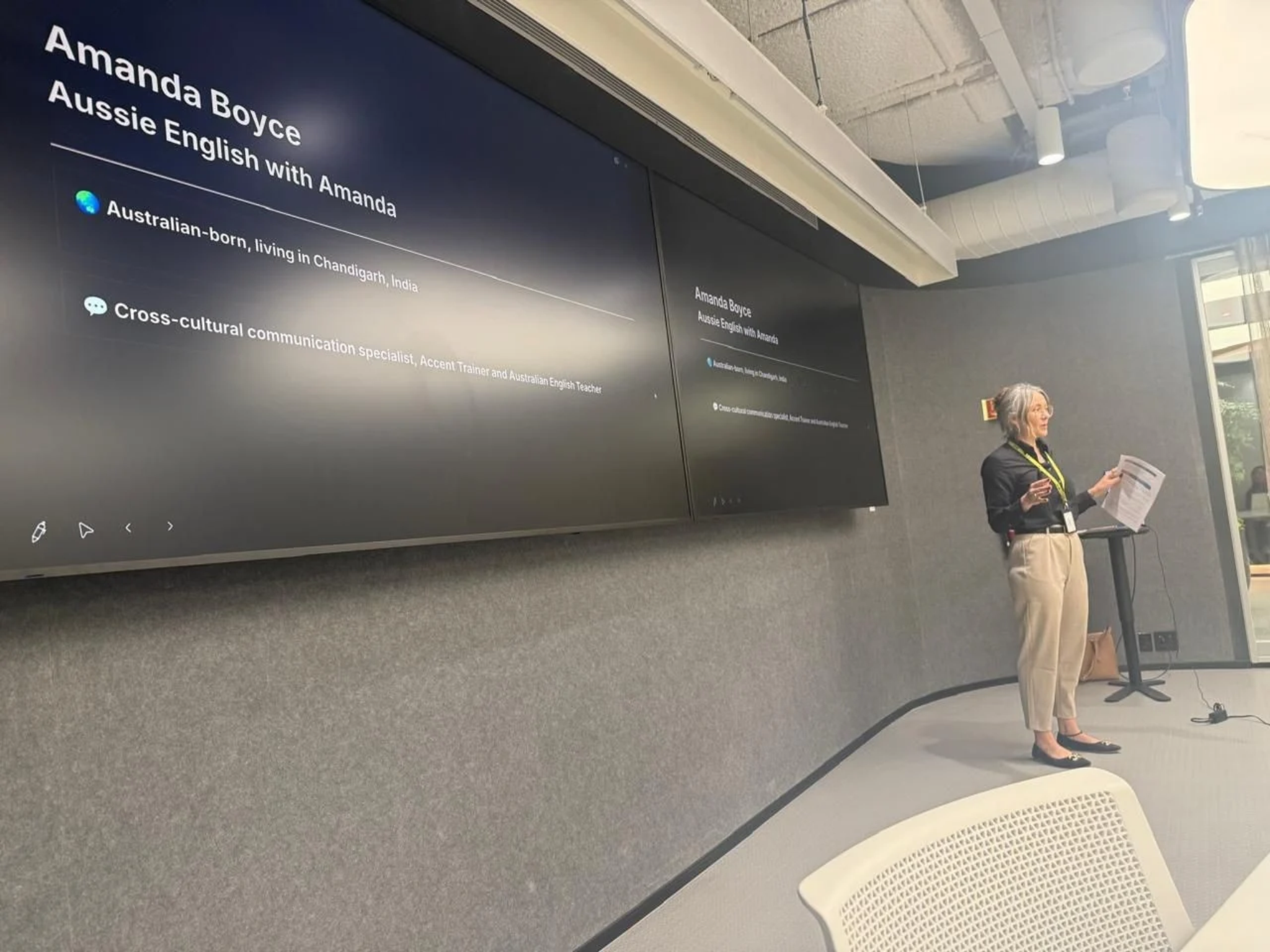
Hi, I'm Amanda 👋
I'm an Australian accent and communication specialist based in North India, working with Australian companies and their India-based teams. I treat communication as a business performance issue, not a language problem.
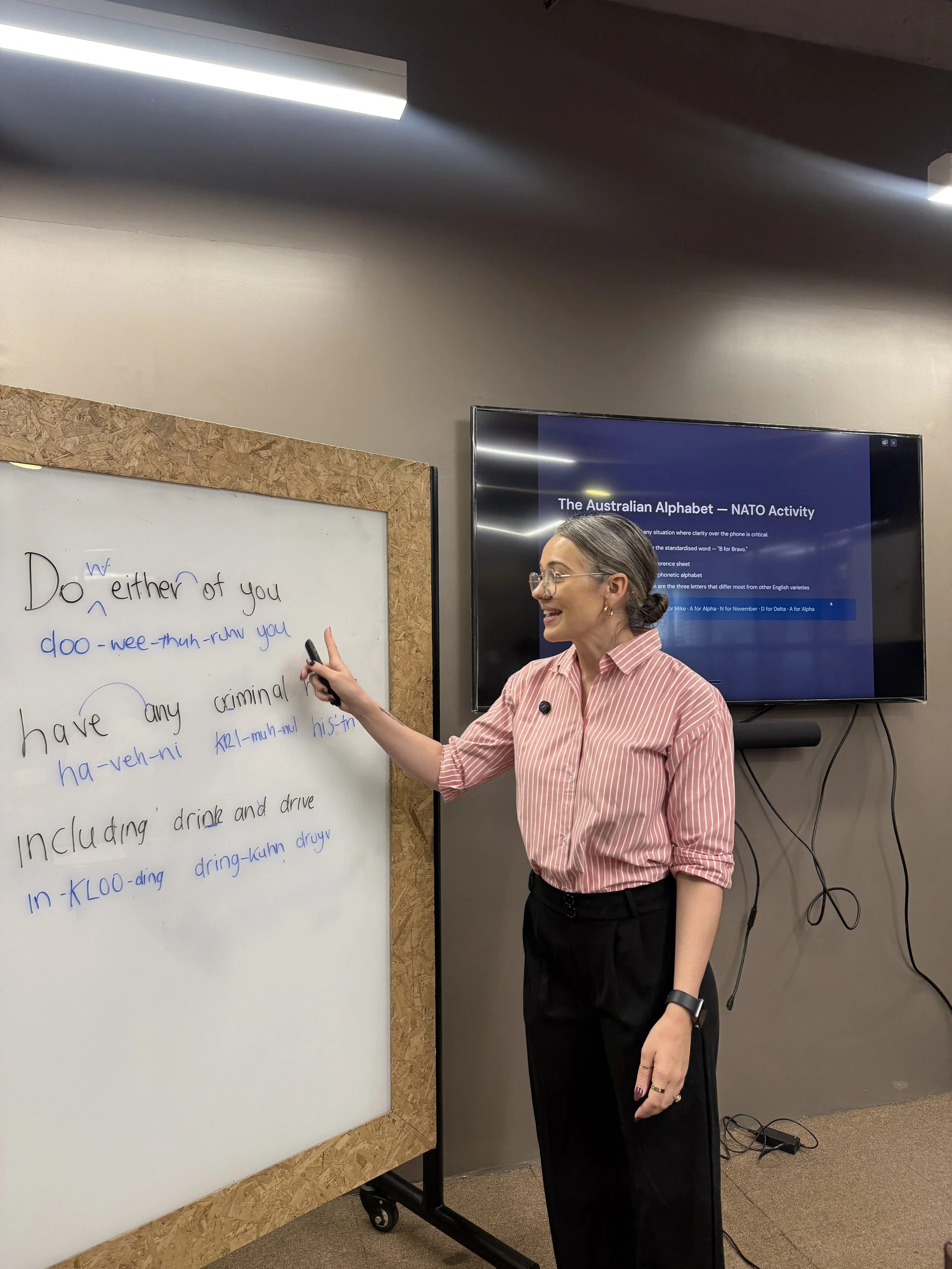
With over 9,000 training sessions delivered across banking, healthcare, consulting, BPO, and customer service, I've worked with more than 1,500 professionals across Australia and India. I've delivered multiple Australian Culture and Communication Workshops for National Australia Bank's Gurugram Innovation Centre, and I'm currently delivering a twelve-week voice and accent program for Loch Corporate Services, working with their client executive team who support a large Australian firm.
Originally from Australia and based in Chandigarh since 2019, I'm also learning Hindi. I know firsthand what it feels like to navigate language and culture from the inside. That shapes how I train: practical, specific, and grounded in real workplace scenarios.
View My Trainer ProfileWhen Communication Gaps Become Business Risks
If you're an L&D leader at an Australian company with teams in India, you've likely heard these concerns from Australian stakeholders:
- "We can't understand your team. Clients keep asking them to repeat themselves."
- "Customer complaints are increasing due to unclear communication."
- "Your team sounds hesitant or comes across the wrong way in client calls."
- "They're not aligning with Australian business culture or expectations."
Generic Business English training hasn't fixed it. Your team needs Australian-specific communication skills.
The Cost of Inaction
Poor communication is a business performance issue, not just a people issue. The research is consistent.
86% of employees and executives attribute workplace failures to a lack of effective communication. On a practical level, organisations lose over $15,000 per employee each year due to wasted time, project delays, and missed opportunities. Among customers who moved to a competitor, 66% cited poor communication skills of company representatives as the reason.
For Australia-facing teams, the stakes are higher. When the communication gap is cultural and linguistic as well as structural, generic training doesn't close it. The misalignment shows up in every client call, every email, and every escalation.
Sources: Project.co 2024, Harvard Business Review, Grammarly State of Business Communication 2024
Australian-Specific Training That Works
I provide customised communication training for India-based teams at Australian companies, addressing the specific gaps that cause client complaints and communication breakdowns.
Australian Workplace Focus
Not generic Business English. Training built on Australian pronunciation patterns, workplace tone, and communication expectations that your clients and colleagues actually use.
Measurable Business Outcomes
Every engagement includes a Training Needs Analysis, pre- and post-assessments, and outcome reporting. You'll have something to show leadership beyond completion certificates.
Customised for Your Team
Role-specific scenarios for your industry, whether banking, healthcare, tech, or customer service. No off-the-shelf content, and no generic examples that don't reflect your team's actual work.
Flexible Implementation
Start with a pilot group of 10 to 15 people to test the approach before a wider rollout. Delivery can be in-person, virtual, or hybrid to suit your team's schedule and location.
What Changes After Training
Participants and managers consistently report the same shifts.
How We Work Together
A straightforward process from first contact to delivery.
Initial Contact
Complete the form below. I'll follow up by email with a few questions to understand your team's specific needs and communication challenges.
Discovery and Assessment
After our initial email exchange, we can schedule a call if it looks like a good fit. We'll talk through your business goals, your team's context, and what success looks like.
Customised Program Design
A training plan tailored to your team's roles, industry, and communication challenges, with clear timelines and measurable outcomes aligned to your goals.
Flexible Delivery
Live virtual sessions, on-site workshops, or a blended approach. We can start with a pilot group of 10 to 15 people to validate the program before scaling.
What People Say
"Understanding the differences between sounds, contractions, and schwa was the best. Now I lead client calls with confidence."
"The improvement in tone, emotion, pausing, and sounds such as TH, AY, R, and linking words was immediately noticeable. Every bit of time, energy, and money invested is absolutely worth it."
"I feel more confident because I've learnt to communicate in ways specific to Australians through tone modification, slang, and small talk. Small talk and tone feel easier now, and I'm less confused. I've also become more chatty with customers and colleagues."
"I feel very much more confident as I now apply the rising and falling of tones. I'm also much more aware of cultural differences. Communication skills feel easier, especially using an empathetic tone when talking to a distressed customer. There has been an improvement in how both team members and patients respond to me."
"Amanda helped me identify the sounds I was struggling with and gave me clear, practical tools to improve them. This not only changed how I speak but also how I listen and understand others. Her program is well-structured and thoughtful, from the initial pronunciation assessment to each stage of progress."
"Strongly recommended. Amanda always requests feedback to ensure that she is delivering the best experience."
From day one to client-ready
How a newly hired team in Gurugram built the communication skills and cultural fluency to handle Australian client calls with clarity and warmth.
A brand new team, taking Australian calls within weeks
Loch Corporate Services is an India-based operations business whose client executives take calls from Australian clients, answering enquiries, booking consultations and working through complications. Many callers are stressed or confused, and the matters they're calling about affect their lives.
The team was freshly hired, so this program was part of their onboarding. They were learning the systems, the workflows and how to communicate with Australian clients all at the same time.
Solid English, and a new kind of conversation
All three came in with strong English and a real commitment to the job. Australian English and client-facing call work were both new.
Their first recordings showed the same patterns across the group: W and V swapping in connected speech, the FACE and GOAT vowels flattening, an R pronounced where Australians drop it, and an even, syllable-timed rhythm that an Australian listener notices straight away.
Small phrases an Australian caller notices
Some phrases sound completely natural in Indian English and slightly off to an Australian ear. We worked on these across the whole program, because across a full call they shape how the caller feels about the person helping them.
Built around the calls they'd actually take
The Australian sound system and the phone
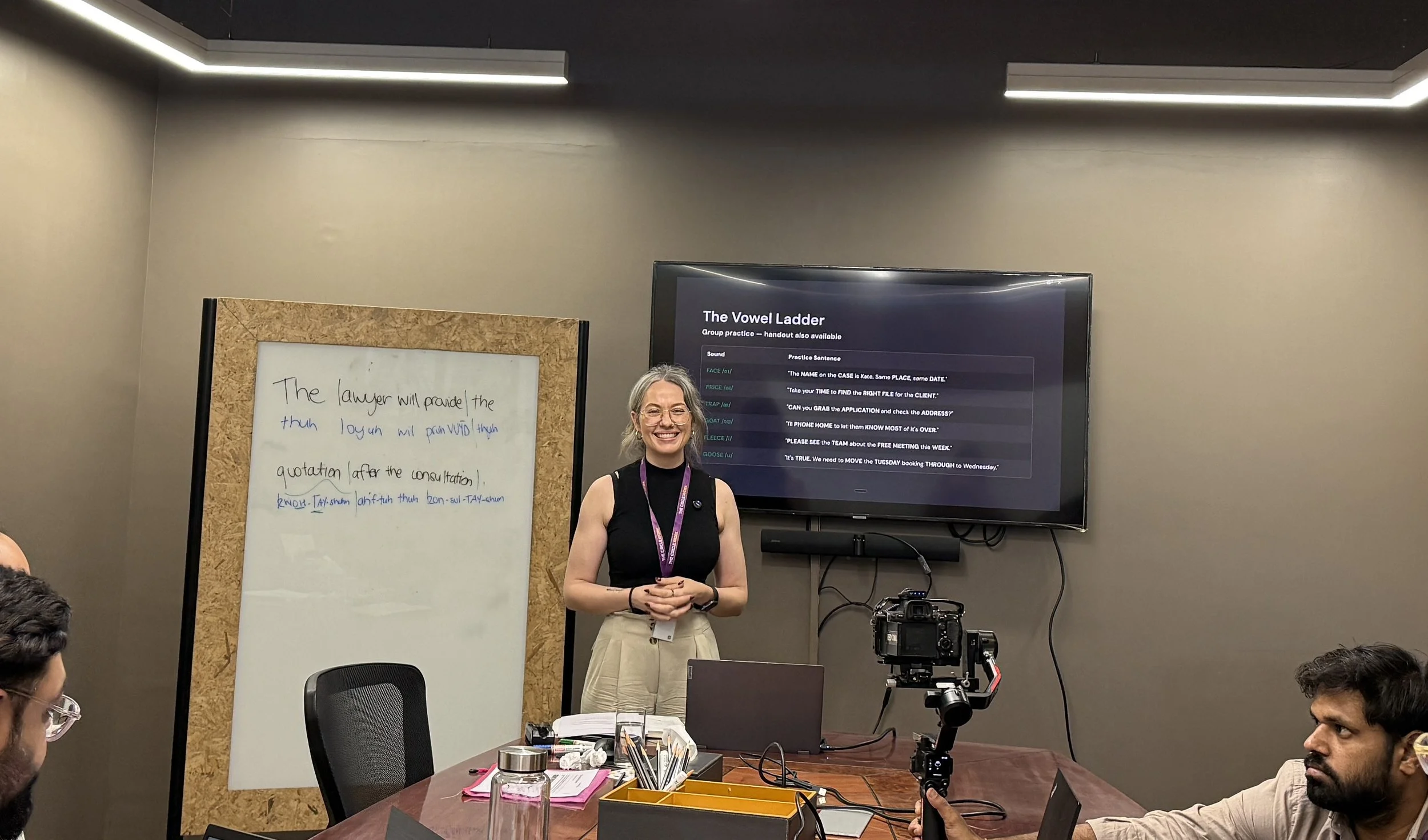
The vowel ladder, connected speech, the verbal handshake, the NATO phonetic alphabet, signposting, and the HEAR framework for difficult callers.
Real conversations
Australian telephone voice, simplifying jargon, the impatient caller, the caller who says it's too expensive, and staying warm when a call goes sideways.
Mid-program assessmentIntegration
Dedicated work on the non-rhotic R, advanced fluency, and full workflow simulations from the first hello to the final confirmation.
Final assessment and graduationFull call simulations, scored on more than sound
Each simulation was a complete call scenario, scored out of 80 with a pass mark of 52, across four areas.
What changed on their calls
Participant One
He named pace as his growth area in the very first session, and his early recordings were rushed and hard to follow. In his final simulation he stayed measured and direct with a businesslike caller who wanted answers quickly.
Participant Two
His score went up at every assessment. In the final simulation a caller was frightened and speaking quietly. He slowed down, kept his language simple, let the silences sit, and confirmed her details carefully.
Participant Three
Her focus on sounds flattened her natural warmth at the mid-program assessment, and she missed the pass mark by one point. She kept working, rebuilt in Phase 3, and finished 11 points higher with her intonation fully back.
I feel confident and well-prepared to start speaking with Australian clients. The program has given me a strong foundation in communication, pronunciation, and handling different scenarios, and I am looking forward to applying what I have learned in real client interactions and continuing to grow through experience.Participant Three, Loch Corporate Services, final program feedback
Does your India-based team talk to Australian clients every day?
Every role play and simulation in this program was built around the calls this team would actually handle. I can build the same for yours.
From day one to client-ready
How a brand new team built the communication skills and cultural fluency to handle Australian client calls.
When Loch Corporate Services reached out to me about training their client-facing team, the brief was clear and the challenge was real. They had a brand new team, freshly hired, who would be handling calls with Australian clients. Everything was arriving at once: the systems, the workflows, and the communication skills they'd need to do the job well. This program was part of their onboarding from the start.
Loch Corporate Services is an India-based operations business whose client executives take calls from Australian clients, answering enquiries, booking consultations and working through complications. Many callers are stressed or confused, and the matters they're calling about affect their lives. The team needed to sound like they belonged on an Australian call from their first day on the phones, and to understand what an Australian caller expects from that conversation.
We ran a 24-session Australian communication and accent training program across 12 weeks, from 15 June to 15 September 2026. The first two sessions were in person in Gurugram and the remaining 22 were online. Three client executives completed the full program, and they're referred to here as Participant One, Two and Three.
Where they started
All three came in with solid English and a real commitment to doing the job well. They weren't starting from scratch with the language, but Australian English and client-facing call work were both new, and they were learning them alongside everything else.
In the pre-program survey, all three rated their speaking confidence at 4 out of 5. What they wrote next to that number said more. Participant One named understanding different accents and adapting to them as his biggest challenge. Participant Two said getting familiar with the Australian accent. Participant Three went straight to pronunciation, naming vowel sounds and articulation.
The baseline recordings showed the same patterns across the group. W and V were swapping in connected speech. The FACE and GOAT diphthongs were flattening into single vowels. R was pronounced in positions where Australian English drops it. And the rhythm was syllable-timed, with even spacing between words, which is one of the first things an Australian listener notices in Indian English.
The program
Phase 1 covered the Australian sound system and professional telephone communication. We worked through the vowel ladder, connected speech, the verbal handshake, the NATO phonetic alphabet, signposting, and the HEAR framework for handling difficult callers. Everything we practised connected directly to calls they'd be taking within weeks, and all three scored 20 out of 20 on the knowledge quiz at the end of the phase.
Phase 2 moved into Australian telephone voice and real conversations, and the role plays got harder. We worked on accent awareness, simplifying jargon, the impatient caller, the caller who says it's too expensive, and staying warm and professional when a conversation goes sideways. The mid-program assessment in Session 16 was the first formal test of how far they'd come.
Phase 3 was integration. We swapped the written communication module for dedicated sessions on the non-rhotic R and pronunciation consolidation, then moved into advanced fluency work and full workflow simulations. Session 24 was the final assessment and graduation.
How we assessed
Each formal simulation was a complete call scenario, scored out of 80 with a pass mark of 52, across four areas: pronunciation and fluency, warmth and empathy, handling the complication, and overall confidence and professionalism. Alongside the simulations, each participant recorded the same reading passage at three points in the program so we could track their sounds, rhythm and intonation over time.
All three passed their final simulation, with scores of 60, 64 and 62.
Cultural fluency on the call
The phrases that sound natural in Indian English but slightly off to an Australian ear were a consistent focus across the program. "Post that" became "after that." "Could you please confirm me" became "could you please confirm." "Postal code" became "postcode." "I'll request you" became "could you please." Each one is a small change on its own, and across a whole call they add up to a team that sounds like they understand who they're talking to.
On the pronunciation side, the W and V substitution and the R shifted most visibly. Both were present for all three at the start, and both had reduced significantly by the final sessions, with the non-rhotic R improving most after the dedicated sessions in Weeks 9 and 10.
The weekly feedback forms show how their awareness grew. In Week 5, the most useful content was accent types and Australian slang. By Week 8, all three were naming role plays as the most valuable activity and pointing to specific sounds they were working on. By Week 11, Participant Two described sounds as "coming more naturally," Participant Three said her off-script delivery had "improved a lot," and Participant One rated the session 5 out of 5 and named shadow speaking as the moment things clicked.
Participant One: the pace shift
Participant One named pace as his personal growth area in the very first session. His early recordings had a rushed, compressed quality that made him harder for a listener to follow. By the final simulation he was measured, direct and confident with a businesslike caller who wanted answers quickly and had no interest in small talk.
He finished with a final simulation score of 60 out of 80. In his final feedback he rated both his speaking confidence and his confidence with difficult callers at 5 out of 5, and said nothing was making him nervous about starting live calls.
Participant Two: consistent from start to finish
Participant Two was the most consistent performer in the group. His simulation score went up at every assessment, finishing at 64 out of 80, his strongest result of the program.
His warmth and emotional intelligence stood out from Session 1. In the final simulation, he took a call from someone who was frightened and speaking quietly about a difficult situation. He slowed down, simplified his language, let the silences sit without rushing to fill them, and confirmed her details carefully so she got the right information. That kind of judgement on a call builds over weeks of practice.
In his final feedback, he listed what he was most proud of: his vowel sounds, W and V, linking, contractions, intonation, and bringing everything together. That list shows how much his awareness of his own speech had grown.
Participant Three: the dip and the rebuild
Participant Three came in with natural warmth, expressive intonation and strong self-awareness. She named vowel sounds and articulation as her focus and got straight to work.
By the mid-program assessment, something had shifted. Her intonation, one of her strongest areas, had flattened, and her simulation came in at 51, one point under the pass mark.
I always explain this pattern clearly when it comes up. When someone is concentrating hard on specific sounds, the focus on accuracy temporarily flattens the warmth and rhythm they already had. The sounds get more accurate, the delivery gets more careful, and the overall impression suffers for a while. It's a normal stage, and it passes with practice.
She took that feedback and kept working, and in Phase 3 she rebuilt. Her intonation came back to 5 out of 5, her confidence and professionalism score went from 6 to 8, and her final simulation scored 62 out of 80, up 11 points from mid-program. She also handled a complication in that final call that would have rattled plenty of experienced callers, and she handled it cleanly.
In her final feedback form she wrote:
"I feel confident and well-prepared to start speaking with Australian clients. The program has given me a strong foundation in communication, pronunciation, and handling different scenarios, and I am looking forward to applying what I have learned in real client interactions and continuing to grow through experience."
At the end of our final session, she said it had been a privilege to be guided through the program.
Graduation day
Session 24 was graduation day. We played each participant's Session 1 recording next to their Session 24 recording, and the difference was audible to everyone in the room, including the participants themselves. Participant One's pace had slowed and steadied. Participant Two had gone from animated and a little over-produced to warmer and more grounded. Participant Three's intonation had fully recovered.
All three passed their final simulations, received their Certificate of Completion, and left with specific practice recommendations to carry into their live calls.
What this program delivers
A 12-week program like this is a sustained, structured investment in your team's ability to represent your business clearly and warmly to Australian clients. The results at Loch Corporate Services show what's possible when a team is committed, when management backs the work, and when the training is built around the actual scenarios the team will face.
Every role play, drill and simulation was built around the exact call types this team would be handling: enquiries, complicated calls and sensitive protocol calls. They went into live calls with a foundation in Australian communication and call culture that would otherwise take years of trial and error to build.
The Loch Corporate Services program ran from 15 June to 15 September 2026 across 24 sessions, with two in-person sessions in Gurugram and 22 online via Zoom. Three participants completed the full program.
Interested in a communication training program for your team? Get in touch to talk about what a tailored program could look like for your business.
Talk to me about your teamLooking for One-on-One Coaching?
This page is for corporate team training only. If you're an individual living and working in Australia looking to improve your pronunciation and accent clarity, have a look at the Accent Clarity Transformation Program, my 12-week one-on-one coaching package.
Learn About 1:1 CoachingReady to Improve Your Team's Communication?
Complete the form below to get in touch. I'll follow up by email, and we can schedule a call if it looks like a good fit.